
Artificial intelligence startups face financial challenges that extend beyond those of traditional technology companies. High computing costs, unpredictable infrastructure requirements, specialized engineering talent, and evolving revenue models make financial leadership particularly important.
For founders building AI-powered applications, machine learning platforms, or AI infrastructure businesses, choosing the right Chief Financial Officer (CFO) can influence how effectively the company manages capital, evaluates growth opportunities, and prepares for future investment.
The best CFO for AI startups is not necessarily the executive with the longest corporate finance résumé. It is someone who understands venture-backed business models, technology-driven cost structures, cash runway management, and the financial implications of scaling AI products.
An effective AI startup CFO combines financial strategy with the ability to collaborate closely with engineering, product, and commercial leadership.
Why Choosing the Right CFO Matters for AI Startups

AI startups often invest significant resources before achieving predictable commercial revenue.
Model development, GPU infrastructure, cloud services, data processing, and research personnel can generate substantial expenses during the earliest stages of a company’s growth.
At the same time, commercial performance may depend on usage-based pricing, enterprise contracts, subscription revenue, or a combination of different models.
These characteristics can make financial forecasting more complex.
For example, an AI startup may experience rapid customer adoption while its inference expenses increase at a similar or faster rate.
Another company may secure a substantial enterprise contract but need to make infrastructure investments before collecting the related revenue.
A qualified CFO helps founders understand these financial relationships and evaluate how strategic decisions affect profitability, liquidity, and future funding requirements.
The goal is to establish financial discipline without unnecessarily limiting innovation.
 1. Look for Experience With Venture-Backed Technology Companies
Relevant startup experience should be one of the first considerations when selecting a CFO.
Venture-backed businesses operate under financial conditions that differ from those of mature, profitable companies.
Founders must often balance aggressive growth objectives with limited capital, uncertain revenue, and expectations associated with future financing rounds.
A CFO with venture-backed experience should understand:
- Seed, Series A, and later-stage financing requirements
- Cash runway and burn rate management
- Investor reporting and board communication
- Financial modeling for high-growth businesses
- Capitalization tables and dilution scenarios
- Fundraising preparation and financial due diligence
Experience with AI businesses can be particularly valuable, but the candidate should also demonstrate a strong understanding of the company’s specific business model.
A CFO who has worked with an enterprise AI application company may bring different experience from someone who has managed the finances of a compute-intensive AI infrastructure provider.
Founders should evaluate the relevance of that experience rather than relying exclusively on industry labels.
 2. Evaluate Their Understanding of AI Infrastructure Economics
Infrastructure economics can significantly influence the financial performance of an AI startup.
Depending on the product, operating costs may include GPU computing, cloud hosting, model inference, data storage, third-party APIs, and training or fine-tuning workloads.
These expenses may change rapidly as customer usage increases.
A strong AI startup CFO should be able to work with engineering leadership to identify the financial drivers behind infrastructure spending.
For example, the CFO should understand how changes in inference volume, model selection, or vendor pricing may affect gross margin.
The CFO does not need to be a machine learning engineer.
However, financial leadership should be capable of translating technical operating assumptions into budgets, forecasts, and unit economics.
Important areas of evaluation include compute cost per workload, infrastructure utilization, vendor commitments, and the relationship between product usage and revenue.
This knowledge helps management determine whether growth is creating sustainable financial value.
3. Prioritize Cash Runway and Burn Rate Forecasting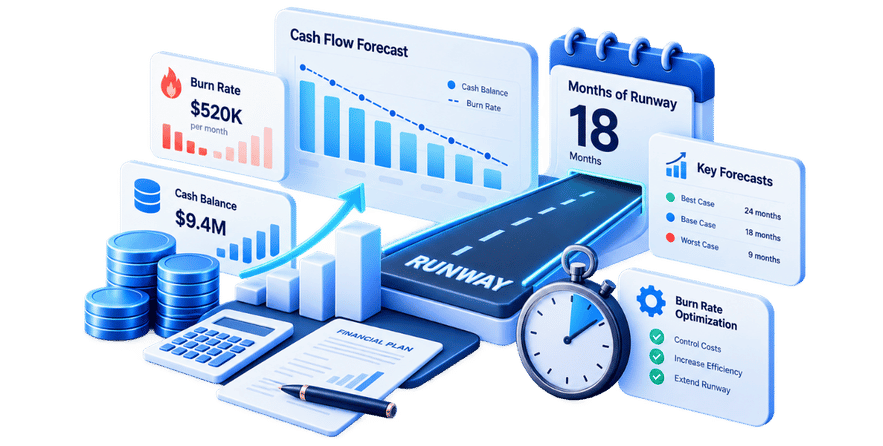
For early-stage AI companies, cash runway is often one of the most important indicators of financial flexibility.
Significant research and development spending can create substantial cash requirements before products generate reliable revenue.
A qualified CFO should establish rolling cash flow forecasts that incorporate expected customer collections, engineering payroll, infrastructure expenses, recruitment plans, and operating commitments.
Forecasting should also account for large or irregular expenditures, such as model training projects, prepaid cloud commitments, or equipment purchases.
Scenario analysis is essential.
Management should understand how different operating assumptions affect available cash.
For example, the company may need to evaluate the impact of:
- Slower-than-expected enterprise customer acquisition.
- Higher GPU or cloud computing expenses.
- Accelerated engineering recruitment.
- Delayed fundraising.
- Lower gross margins due to increased inference usage.
The best CFO should help founders use these scenarios to make practical capital allocation decisions rather than simply presenting financial projections.
4. Assess Their Ability to Build AI-Specific Unit Economics
Traditional software metrics may not fully explain the economics of an AI business.
For companies with substantial usage-dependent infrastructure costs, revenue growth alone may provide an incomplete picture of financial performance.
A CFO should develop financial reporting that reflects how the company’s products generate revenue and incur costs.
Relevant metrics may include:
| Financial metric | Why it matters |
|---|---|
| Gross Margin | Evaluates revenue remaining after applicable service delivery costs |
| Cost per Inference | Measures the expense associated with processing an AI request |
| Compute Cost per Customer | Connects infrastructure spending with customer activity |
| Contribution Margin | Evaluates revenue remaining after defined variable costs |
| Customer Acquisition Cost (CAC) | Measures customer acquisition efficiency |
| CAC Payback Period | Estimates the time required to recover acquisition costs through customer gross profit |
| Customer Lifetime Value (LTV) | Estimates the economic value of a customer relationship |
| Net Burn Rate | Tracks cash consumption after operating cash inflows |
Not every metric applies to every AI startup.
A model development company, an AI-enabled SaaS provider, and an inference infrastructure business may require different financial analyses.
The CFO should define metrics consistently and ensure that management understands the assumptions behind them.
5. Choose a CFO Who Understands AI Pricing Models
AI startups increasingly use pricing structures that differ from conventional software subscriptions.
Depending on the product, customers may pay through monthly subscriptions, token consumption, API calls, computing time, enterprise licenses, or hybrid arrangements.
Each pricing model creates different financial risks and opportunities.
For example, fixed subscription pricing can improve revenue predictability but may expose the company to higher costs when customer usage exceeds expectations.
Usage-based pricing may align revenue with consumption but introduce variability into financial forecasts.
A CFO should help management evaluate how pricing affects revenue, gross margin, customer acquisition, and cash flow.
This analysis should incorporate infrastructure costs, expected usage patterns, customer segments, and contractual commitments.
The objective is to support pricing decisions that reflect both customer value and the economics of delivering the AI product.
6. Evaluate Fundraising and Investor Reporting Capabilities
For venture-backed AI startups, the CFO should play an important role in financial preparation for investment rounds.
Investors may evaluate revenue growth, gross margins, infrastructure efficiency, cash runway, capital requirements, and the scalability of the company’s business model.
A CFO should establish consistent reporting processes that help management communicate financial performance clearly.
Responsibilities may include preparing financial projections, analyzing financing scenarios, organizing due diligence documentation, and supporting board reporting.
The CFO should also understand how financing decisions affect dilution and future capital requirements.
Strong financial reporting does not guarantee a successful fundraising outcome.
However, reliable information and clearly documented assumptions can help founders present their financial strategy more effectively.
 7. Look for Financial Systems and Reporting Expertise
AI startups often begin with relatively simple financial processes.
As the company grows, increasing transaction volumes, usage-based billing, infrastructure vendors, and enterprise contracts can make reporting more complex.
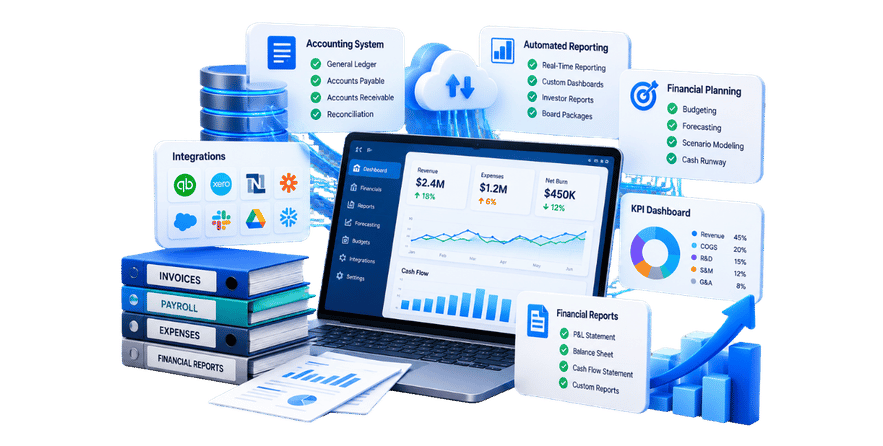
A CFO should evaluate whether the company’s financial systems can support these requirements.
Priorities may include automated billing reconciliation, infrastructure cost allocation, monthly closing procedures, financial reporting dashboards, and appropriate internal controls.
For U.S. companies, accounting considerations may involve revenue recognition under ASC 606, stock-based compensation under ASC 718, and applicable guidance for research and software development expenditures.
The correct treatment depends on the company’s specific transactions and circumstances.
A qualified CFO should coordinate with accounting, tax, and legal specialists when technical expertise is required.
The objective is to establish financial infrastructure that supports growth without introducing unnecessary complexity.
8. Assess Strategic Communication and Collaboration Skills
Technical financial expertise is essential, but it is not sufficient on its own.
The best CFO for an AI startup should be able to communicate effectively with founders, engineering teams, investors, and other stakeholders.
Financial decisions frequently involve trade-offs between product performance, infrastructure spending, commercial growth, and available capital.
For example, engineering leadership may recommend investing in additional computing capacity to improve product performance.
The CFO should help evaluate the financial implications of that recommendation, including upfront costs, operating expenses, expected customer demand, and potential returns.
This requires collaboration rather than purely financial oversight.
A strong CFO should challenge assumptions constructively, explain risks clearly, and help management make decisions supported by reliable financial information.
Fractional CFO vs. Full-Time CFO for AI Startups
Not every AI startup requires a permanent CFO.
For early-stage and growing companies, a fractional CFO can provide experienced financial leadership through a flexible engagement.
| Consideration | Fractional AI CFO | Full-Time AI CFO |
|---|---|---|
| Engagement | Part-time or flexible | Permanent executive |
| Cost structure | Retainer or defined scope | Salary, benefits, and potentially equity |
| Financial forecasting | Provided within engagement scope | Continuous responsibility |
| Infrastructure cost analysis | Can be included in scope | Ongoing oversight |
| Investor reporting | Can be managed or supported | Continuous executive responsibility |
| Strategic involvement | Based on agreed availability | Dedicated executive capacity |
| Best suited for | Startups needing senior financial expertise without a full-time role | Companies with substantial ongoing financial complexity |
A fractional CFO may be particularly suitable for a Seed or Series A AI startup seeking to strengthen financial planning, manage runway, or prepare for fundraising.
A full-time CFO may become more appropriate as infrastructure commitments, financing activity, operational complexity, and executive responsibilities increase.
The decision should reflect the company’s actual needs rather than its funding stage alone.
How to Choose the Best CFO for Your AI Startup: A Practical Checklist
Founders can use the following criteria when comparing CFO candidates.
| Selection criterion | What to evaluate |
|---|---|
| Venture-backed experience | Familiarity with startup financing and investor expectations |
| AI cost understanding | Ability to analyze GPU, cloud, and inference economics |
| Financial forecasting | Experience developing runway and scenario models |
| Unit economics | Ability to connect customer revenue with infrastructure costs |
| Fundraising support | Financial modeling, due diligence, and investor reporting |
| Financial infrastructure | Experience establishing scalable reporting and controls |
| Strategic communication | Ability to collaborate with technical and executive teams |
During interviews, founders should ask candidates to explain how they would approach the company’s specific financial challenges.
A practical discussion of the business model, cost structure, and operating priorities can be more informative than a generic presentation of previous executive experience.
Five Questions to Ask a Potential AI Startup CFO
- How would you evaluate our GPU, cloud, and inference spending?
- Which financial metrics would you prioritize for our AI business model?
- How would you forecast cash runway under different infrastructure and revenue scenarios?
- What financial information would you prepare before our next funding round?
- What would your financial priorities be during the first 90 days?
The responses should demonstrate practical financial judgment, familiarity with startup operations, and an ability to adapt to the company’s specific needs.
How ERB Proximo Supports AI Startups
ERB Proximo provides outsourced CFO and financial management services for startups and growing companies operating in the United States.
For AI startups, effective financial leadership requires connecting financial planning, cash flow management, accounting, and performance reporting within a coordinated framework.
ERB Proximo’s services encompass CFO-level oversight, financial planning and analysis, accounting, controllership, and financial reporting.
These capabilities can help founders improve financial visibility, develop more structured forecasting processes, and support strategic capital allocation decisions.
For companies evaluating a fractional CFO model, an integrated financial management approach can provide access to senior financial oversight alongside the accounting and reporting processes needed to support growth.
Frequently Asked Questions
1. What makes a CFO suitable for an AI startup?
A suitable AI startup CFO combines financial planning, venture-backed startup experience, cash runway management, and an understanding of AI-related cost structures. The CFO should also be able to collaborate with technical leadership and support investor reporting.
2. Does an AI startup need a specialized CFO?
Not every AI startup needs a CFO with previous experience in artificial intelligence. However, the CFO should understand the company’s business model, infrastructure economics, pricing structure, and capital requirements.
3. When should an AI startup hire a CFO?
An AI startup should consider CFO-level support when infrastructure spending increases, cash forecasting becomes more complex, fundraising approaches, or management needs more sophisticated financial reporting.
4. Can a fractional CFO help an AI startup raise capital?
Yes. A fractional CFO can support fundraising by preparing financial models, organizing due diligence materials, analyzing financing scenarios, and improving investor reporting. Fundraising success depends on additional factors beyond financial preparation.
5. What financial metrics should an AI startup CFO monitor?
Relevant metrics may include gross margin, contribution margin, compute cost per customer, cost per inference, CAC, LTV, burn rate, and cash runway. The appropriate metrics depend on the company’s operating model.
6. Is a fractional CFO better than a full-time CFO for an early-stage AI startup?
A fractional CFO can be an efficient option for companies that need experienced financial guidance but do not require continuous executive involvement. A full-time CFO may be more suitable when financial operations and strategic responsibilities become sufficiently complex.
Choosing Financial Leadership for Sustainable AI Growth
Selecting the best CFO for an AI startup requires more than evaluating traditional accounting credentials.
Founders need financial leadership that understands the relationship between computing infrastructure, product development, customer economics, capital allocation, and future financing requirements.
The right CFO should provide reliable financial visibility while helping management make strategic decisions in a rapidly evolving technology environment.
Whether through a fractional or full-time engagement, experienced CFO leadership can help AI startups establish stronger financial processes, manage capital more effectively, and prepare for their next stage of growth.
Looking for CFO-level financial support for your AI startup?
Explore how ERB Proximo’s outsourced CFO and financial management services can support forecasting, financial reporting, and strategic decision-making as your company grows.