
At some point in a startup’s growth, financial leadership stops being optional.
The company may have raised institutional capital, expanded its workforce, entered new markets, developed increasingly complex revenue streams, or reached the point where investors and board members expect more sophisticated reporting. Founders begin asking questions that cannot be answered by bookkeeping or historical financial statements alone.
How much runway do we really have?
Can we afford the next phase of hiring?
What happens if revenue grows 20% slower than expected?
When should we raise our next round?
Are our unit economics improving?
What financial information will investors expect at the next board meeting?
At this stage, many founders know they need CFO-level expertise. The harder decision is whether to hire a Fractional CFO or recruit a Full-Time CFO.
Both models can provide strategic financial leadership. The right choice depends less on company age and more on complexity, scale, management requirements, funding stage and how much executive-level finance work the business actually requires.
For many U.S. startups, particularly companies between early institutional funding and later-stage scale, a fractional CFO can provide the expertise of an experienced finance executive without requiring the company to build a full-time executive finance position prematurely.
For others, financial complexity has reached the point where a dedicated CFO needs to be embedded in the organization every day.
Understanding that distinction can prevent one of two expensive mistakes: hiring senior finance leadership before it is necessary, or waiting until the business has already outgrown its financial infrastructure.
What Is a Fractional CFO?
A Fractional CFO is an experienced finance executive who provides CFO-level leadership to a company on a part-time or outsourced basis.
Unlike a bookkeeper or accountant, the fractional CFO is typically responsible for forward-looking financial management rather than simply recording historical transactions.
The role can include:
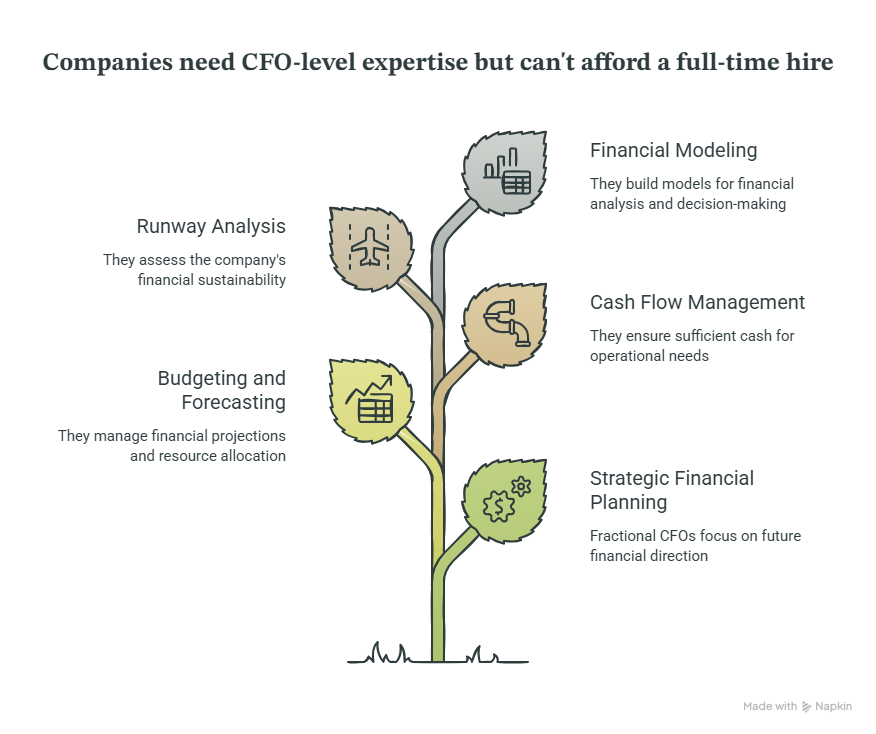
- Strategic financial planning
- Budgeting and forecasting
- Cash flow management
- Runway analysis
- Financial modeling
- FP&A
- Board reporting
- Investor reporting
- Fundraising preparation
- KPI analysis
- Scenario planning
- Capital allocation
- Financial controls
- Finance systems
- Management decision support
The amount of CFO involvement can vary considerably.
An early-stage startup may need several strategic sessions each month plus oversight of forecasting and reporting. A later-stage company may require weekly management involvement, board participation and coordination of an entire outsourced finance team.
The important distinction is that the company receives CFO capability without necessarily hiring a CFO as a full-time employee.
What Is a Full-Time CFO?
A Full-Time CFO is a permanent member of the executive leadership team with day-to-day responsibility for the company’s finance organization.
The role typically becomes appropriate when the financial complexity and strategic requirements of the business justify continuous executive attention.
A full-time CFO may oversee:
- Accounting and controllership
- FP&A
- Treasury
- Tax strategy
- Financial systems
- Capital raising
- Investor relations
- Board reporting
- M&A activity
- Risk management
- Internal controls
- Strategic planning
- Finance team development
In a mature organization, the CFO may also manage a substantial internal department consisting of controllers, finance managers, analysts, accountants and operational finance professionals.
The question for startup founders is therefore not whether a full-time CFO provides value.
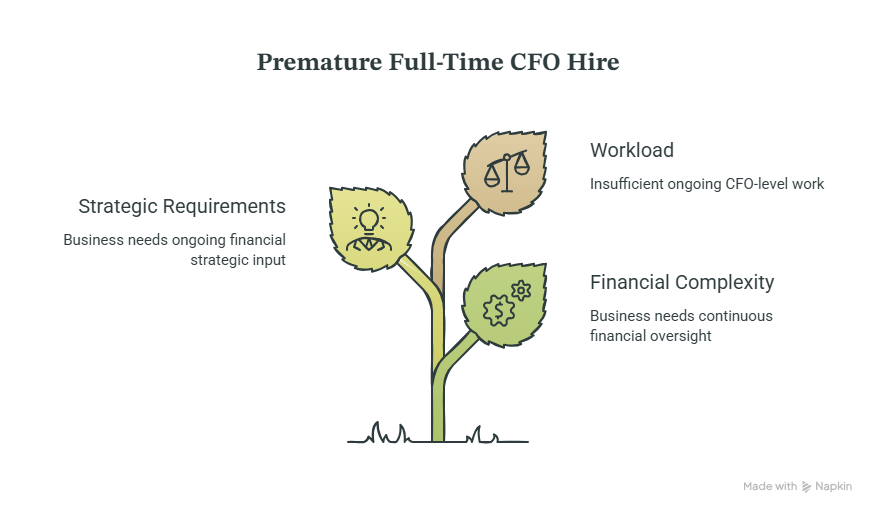
The question is whether the company has enough ongoing CFO-level work to justify building the position internally today.
The Most Important Difference: Capacity vs. Capability
The difference between fractional and full-time CFO models is often misunderstood.
It is not necessarily a difference in expertise.
A highly experienced fractional CFO may have served as CFO for multiple venture-backed companies, completed fundraising rounds, built finance organizations and advised boards for years.
The primary difference is capacity.
A fractional CFO allocates part of their professional capacity to the company.
A full-time CFO dedicates all of it.
That distinction matters.
If the company currently needs 10–20 hours of senior finance leadership each week, hiring a highly experienced full-time CFO may create an unnecessarily expensive executive role.
If finance requires continuous executive oversight, daily interaction across departments, frequent board and investor engagement, significant capital-markets activity and management of a large internal finance organization, fractional involvement may no longer be sufficient.
The optimal model is the one that matches the amount and sophistication of financial leadership the company actually needs.
Fractional CFO vs. Full-Time CFO: At a Glance
| Consideration | Fractional CFO | Full-Time CFO |
|---|---|---|
| Typical fit | Early and growth-stage startups | Later-stage or highly complex companies |
| Executive finance expertise | Yes | Yes |
| Time commitment | Flexible | Full-time |
| Cost structure | Variable and scalable | Executive compensation package |
| Speed of implementation | Often faster | Requires executive recruitment |
| Access to supporting team | Often included with provider | Usually built internally |
| Daily management presence | Limited | Continuous |
| Board support | Yes | Yes |
| Fundraising support | Yes | Yes |
| Scalability | Engagement can expand | Finance department scales internally |
| Best use case | CFO expertise needed before full-time role is justified | Finance requires dedicated executive ownership |
Neither model is inherently superior.
The question is which structure matches the startup’s current stage.
When Does a Fractional CFO Make the Most Sense?
A fractional CFO is often particularly effective during the transition between founder-led finance and a mature internal finance organization.
Several situations commonly indicate that this model may be appropriate.
You Have Raised Institutional Capital
Once external investors enter the business, financial expectations typically increase.
Management may need monthly reporting, budget-versus-actual analysis, board materials, forecasts, KPI reporting and more disciplined cash management.
The company needs sophisticated finance leadership, but it may still be too early to justify a permanent CFO.
A fractional CFO can establish these processes and provide executive-level oversight while the organization continues to grow.
You Are Preparing for Seed, Series A or Series B
Fundraising creates a concentrated need for financial expertise.
Founders may require:
- Financial modeling
- Scenario analysis
- Investor metrics
- Historical financial analysis
- Due diligence preparation
- Cash requirement planning
- Data-room support
- Management presentations
A fractional CFO can help prepare these materials while continuing to oversee the broader financial operation.
Your Founders Still Own Too Much of Finance
Founder involvement in finance is essential.
Founder dependence on finance administration is not.
If the CEO is personally coordinating accounting, forecasts, payroll questions, investor reports and board materials, the company may need senior finance ownership.
A fractional CFO can take responsibility for the finance process while keeping the founder closely informed on strategic decisions.
You Need Better Forecasting
Accounting explains the past.
A CFO should help management understand the future.
If the company has financial statements but lacks a meaningful rolling forecast, hiring plan, cash model or scenario analysis, it may have reached the point where CFO expertise is required.
Your Board Reporting Is Becoming More Sophisticated
A board package should not require a crisis every quarter.
If management repeatedly rebuilds financial reporting manually before board meetings, the underlying finance process is probably not mature enough.
A fractional CFO can create a repeatable reporting framework that connects financial performance with business strategy.
When Is a Full-Time CFO the Better Choice?
Fractional CFO services are not intended to delay a full-time hire indefinitely.
As startups mature, there comes a point when financial leadership should become permanently embedded in the management team.
Several indicators can suggest that moment has arrived.
Finance Requires Daily Executive Decisions
If significant finance-related decisions occur every day across multiple departments, fractional availability may eventually become limiting.
Large sales contracts, complex capital decisions, acquisitions, international expansion and organizational restructuring may require continuous CFO involvement.
The Internal Finance Team Has Become Substantial
Once the company has controllers, FP&A professionals, accounting managers and finance analysts, the organization may need a dedicated executive responsible for leading that team.
The CFO is no longer only providing advice.
The CFO is managing an organization.
Capital Markets Become a Continuous Responsibility
Later-stage fundraising, debt facilities, secondary transactions, acquisitions or IPO preparation can transform capital strategy into a full-time executive responsibility.
At that point, finance leadership may need to be continuously available to management, investors and outside advisors.
Investor and Board Engagement Is Intensive
Some companies reach a stage where CFO participation in board, investor and strategic discussions becomes frequent enough to justify full-time involvement.
Complexity Is No Longer Episodic
Fractional models work especially well when complexity is significant but manageable within a structured engagement.
Once high-level financial complexity becomes continuous, a full-time CFO may become the more effective structure.
The Cost Question: Compare Value, Not Just Salary
Founders frequently compare fractional and full-time CFO options primarily through cost.
That comparison can be misleading.
A full-time CFO involves more than base salary. Companies may also need to consider bonuses, benefits, equity compensation, recruiting costs and the expense of building the finance team that supports the executive.
A fractional CFO typically operates under a service-based model where the scope can be adjusted according to company needs.
However, the lowest monthly price should not automatically determine the decision.
A startup should ask:
What financial capability are we actually buying?
A low-cost fractional service providing a few hours of monthly consultation is fundamentally different from an outsourced finance organization providing CFO leadership, FP&A, controllership and recurring management reporting.
Similarly, a highly experienced full-time CFO may create enormous strategic value when the organization genuinely requires that level of executive involvement.
The correct comparison is therefore:
Cost relative to required capability.
Do You Need a CFO or a Controller?
Before choosing between fractional and full-time CFO models, founders should confirm that a CFO is actually the role they need.
This distinction is important.
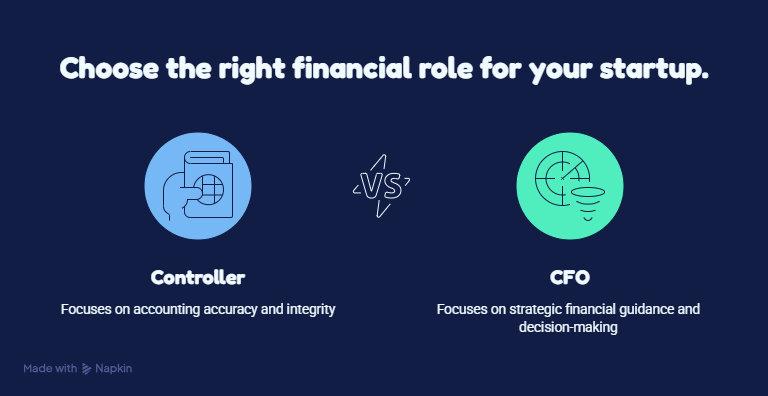
A Controller primarily protects the integrity of the financial information.
A Controller focuses on areas such as:
- Month-end close
- Accounting accuracy
- Reconciliations
- Internal controls
- Accounts payable
- Financial statement preparation
- Accounting policies
A CFO primarily uses financial information to help guide the company.
A CFO focuses on:
- Forecasting
- Strategy
- Capital
- Runway
- Fundraising
- Board reporting
- KPI analysis
- Scenario planning
- Financial decision-making
Sometimes a startup believes it needs a CFO when the immediate problem is poor accounting operations.
Other times, management has excellent books but no one helping interpret the numbers.
A well-designed finance function needs both perspectives.
Strong recordkeeping remains foundational: the IRS notes that good business records support financial statements and help management monitor the progress of a business.
Strategic finance cannot compensate for unreliable accounting data.
Can a Fractional CFO Build the Finance Function?
Yes, and this is often one of the most valuable applications of the model.
A startup may initially have:
- A CPA
- Basic bookkeeping
- Payroll software
- Bank accounts
- Expense management tools
But these components may operate independently.
A fractional CFO can help design an integrated finance architecture that connects:
Accounting → Controllership → FP&A → Management Reporting → Strategic Decision-Making
This may involve establishing:
- Monthly close procedures
- Management reporting schedules
- Budget ownership
- Rolling forecasts
- KPI dashboards
- Cash planning
- Board reporting
- Departmental spending controls
- Financial approval processes
- Finance technology
The objective is to create a function that becomes increasingly sophisticated without introducing unnecessary bureaucracy.
How a Fractional CFO Supports Fundraising
Fundraising is one of the areas where senior finance expertise can create particularly high leverage.
Before beginning investor conversations, founders should understand:
How much capital does the company actually require?
What milestones should that capital fund?
What is the expected runway after the round?
What happens if hiring happens faster than expected?
What happens if revenue grows slower?
How does the company’s financial model connect to its strategic plan?
Investors may also expect consistent definitions of key metrics and assumptions.
The CFO can help ensure that the financial model, historical reporting, operating plan and investor narrative all tell the same story.
A sophisticated CFO does not manufacture a better story.
The CFO creates a financially defensible story.
Fractional CFOs for SaaS Startups
SaaS companies are particularly well suited to CFO-level financial analysis because traditional accounting statements capture only part of the economic picture.
Management may also need to monitor:
- ARR
- MRR
- NRR
- GRR
- Churn
- CAC
- LTV
- CAC Payback
- Gross Margin
- Burn Multiple
- Cash Runway
The value of a CFO is not simply calculating these metrics.
It is interpreting how they interact.
For example:
ARR growth may be strong, but what is happening to customer acquisition efficiency?
Retention may be high, but are gross margins improving?
Revenue may be accelerating, but is the company consuming disproportionately more capital to generate that growth?
That analytical layer is often what separates reporting from financial leadership.
Fractional CFO Support for California Startups
California remains one of the most important U.S. markets for venture-backed technology companies.
Startups operating there can move from relatively simple financial operations to significant complexity quickly as they raise capital, expand headcount and build distributed teams.
A fractional CFO can help founders connect hiring, compensation, revenue planning and fundraising decisions to the company’s financial model.
For a California startup, this may involve questions such as:
Can we support the next hiring plan without shortening runway beyond an acceptable level?
Should we accelerate sales investment?
How does opening another state affect our operating plan?
Is our finance infrastructure ready for the next institutional round?
The CFO should also coordinate with the appropriate accounting, payroll, tax and legal professionals whenever California-specific requirements arise.
The value of the CFO is not replacing those specialists.
It is ensuring that their work fits within one coherent financial strategy.
Fractional CFO Support for New York Startups
New York startups often face similar financial challenges within an ecosystem that includes significant activity in SaaS, FinTech, AI, healthcare, media and other technology sectors.
As the company grows, founders may need stronger management reporting, board materials, financial planning and capital strategy.
A fractional CFO can create an intermediate layer between basic finance operations and a later-stage internal executive team.
For management, this can provide something particularly valuable:
sophisticated finance leadership without prematurely building a large finance department.
What Should a High-Quality Fractional CFO Engagement Include?
Founders should be cautious of engagements where the title “Fractional CFO” is used primarily as a marketing label.
A genuine CFO relationship should produce identifiable business outcomes.
Depending on the company’s stage, that should typically include several of the following:
Financial Forecasting
Management should have a forward-looking financial model that evolves with actual business performance.
Cash and Runway Management
The leadership team should understand liquidity under multiple operating scenarios.
Monthly Management Reporting
Reports should explain performance rather than simply present numbers.
Budgeting
The company’s strategic plan should translate into financial assumptions and departmental accountability.
KPI Analysis
Operating metrics should be consistently defined and linked to financial results.
Board Reporting
The CFO should help management communicate financial performance clearly to directors.
Fundraising Preparation
Financial models, investor questions and due diligence should be anticipated rather than addressed reactively.
Scenario Planning
Management should understand the financial implications of decisions before making them.
What Are the Risks of Hiring a Full-Time CFO Too Early?
Hiring senior finance leadership prematurely can create several problems.
First, the company may be paying executive-level compensation for work that does not yet require full-time CFO capacity.
Second, the CFO may spend a disproportionate amount of time performing work that could be handled by a controller, finance manager or accountant.
Third, founders may build an internal organization before they clearly understand what the finance function should look like.
A fractional structure can create useful flexibility during this stage.
The company can learn:
- Which reporting matters
- Which processes need ownership
- What finance capabilities are required
- How much CFO involvement is actually necessary
- What type of full-time CFO will eventually fit the organization
In this sense, fractional CFO support can also help prepare the company for its eventual permanent CFO hire.
What Are the Risks of Staying Fractional Too Long?
The opposite mistake also exists.
If the company has become complex enough to require continuous executive finance leadership, maintaining a limited fractional arrangement can create bottlenecks.
Potential warning signs include:
- The CFO needs to participate in management decisions almost daily
- The finance team requires continuous leadership
- Capital markets activity has become substantial
- Major transactions are frequent
- Investor relations require significant executive time
- Strategic finance represents a full-time workload
- Management needs the CFO embedded deeply across the organization
A strong fractional CFO should recognize this transition.
The goal should never be to preserve an outsourced engagement indefinitely.
The goal is to build the right finance leadership model for the company’s current needs.
How to Choose a Fractional CFO Provider
Selecting a fractional CFO should be approached like hiring a senior executive.
Founders should ask:
- Who will actually serve as our CFO?
- What startup stages have they worked with?
- Have they supported venture-backed companies?
- What experience do they have with our business model?
- How will they improve our current finance process?
- What does monthly reporting look like?
- How often will forecasts be updated?
- Can they support fundraising and due diligence?
- Can they participate in board meetings?
- How do they coordinate with accountants, tax advisors and legal counsel?
- Can they support multi-state operations?
- What additional finance resources are available?
- How does the engagement scale as our company grows?
- How will they help us transition to a full-time CFO when the time comes?
One of the most revealing parts of the process is not the answers the provider gives.
It is the questions they ask.
An experienced CFO should want to understand the business model, capitalization, investors, cash position, headcount plan, revenue model, current reporting and management priorities before proposing a solution.
ERB Proximo: More Than Fractional CFO Hours
For startups evaluating fractional finance leadership, the real requirement is often broader than access to one CFO for a limited number of hours each month.
A CFO needs reliable financial information, timely reporting and an operational finance infrastructure capable of turning recommendations into action.
ERB Proximo approaches outsourced CFO services as part of an integrated finance function.
Depending on the company’s needs, CFO leadership can operate alongside FP&A, controllership, accounting, reporting and other financial operations within a coordinated team.
This structure addresses one of the common weaknesses of fragmented finance arrangements: strategic advisors working from information produced by entirely separate providers with different processes, systems and timelines.
ERB Proximo’s presence in California and New York also places the firm within two major U.S. startup ecosystems, where it works with founders and growth companies facing increasingly sophisticated financial requirements.
For companies that need senior financial leadership today but may eventually bring the CFO role in-house, the model can also provide continuity during that evolution.
The objective is not simply to outsource a position.
It is to build a finance capability that can mature alongside the company.
Founder Decision Framework: Fractional or Full-Time?
Consider a Fractional CFO when:
You need CFO-level expertise but not every day.
You are preparing for institutional fundraising.
Your board requires better financial reporting.
You need budgeting and forecasting.
Runway has become strategically important.
Your founder is still managing too much finance.
You need better SaaS or operational KPI analysis.
You operate across multiple states.
You have outgrown bookkeeping or basic accounting support.
Hiring a senior CFO today would be financially premature.
Consider a Full-Time CFO when:
Finance requires continuous executive leadership.
You have a substantial internal finance organization.
The CFO is needed in daily operating decisions.
Capital markets activity is ongoing.
Investor relations demand significant executive time.
M&A or major strategic transactions are becoming frequent.
The workload clearly represents a full-time executive function.
The answer may also change over time.
A company can use a fractional CFO today and transition successfully to an internal CFO later.
That is often a sign that the model worked as intended.
Frequently Asked Questions
What is the difference between a fractional CFO and a full-time CFO?
The primary difference is capacity and employment structure. Both can provide strategic financial leadership, but a fractional CFO serves the company on a part-time or outsourced basis, while a full-time CFO is permanently embedded in the organization.
Is a fractional CFO suitable for a venture-backed startup?
Yes. Fractional CFOs can be particularly useful for venture-backed companies that need forecasting, board reporting, investor support and financial strategy but do not yet require full-time executive finance leadership.
When should a startup move from a fractional CFO to a full-time CFO?
The transition typically makes sense when CFO-level responsibilities become a continuous full-time workload, particularly when the company has a substantial finance team, frequent capital activity or significant daily strategic complexity.
Can a fractional CFO attend board meetings?
Yes. Board reporting and participation can be an important component of a fractional CFO engagement, depending on the agreed scope.
Can a fractional CFO help with fundraising?
Yes. Support can include financial modeling, forecasts, due diligence preparation, investor metrics, scenario planning and preparing management to answer financial questions from prospective investors.
Does a fractional CFO replace a Controller?
Not necessarily. The roles are different. A Controller focuses primarily on financial accuracy and accounting operations, while a CFO focuses on strategy, forecasting, capital and management decision-making.
Does a fractional CFO replace a CPA?
No. A CPA and CFO typically perform different functions and can work together. Companies may continue using external tax or audit professionals while the CFO manages strategic finance.
Is a fractional CFO appropriate for a SaaS startup?
Often. SaaS companies may benefit from CFO expertise in recurring-revenue analysis, unit economics, runway planning, investor metrics, forecasting and capital allocation.
Are fractional CFO services useful for California and New York startups?
They can be. Startups in both markets frequently face fundraising, hiring, multi-state growth and sophisticated reporting requirements before they are ready for a permanent CFO.
How should founders choose between fractional and full-time CFO models?
Focus on financial complexity and required executive capacity rather than revenue alone. If the company needs high-level expertise but only part-time executive involvement, fractional CFO services may be more efficient. If CFO responsibilities have become a continuous leadership function, a full-time hire may be appropriate.
The Right CFO Model Should Evolve with the Company
The decision between a Fractional CFO and Full-Time CFO should not be treated as a permanent choice.
It is a question of timing.
Early-stage startups rarely need to recreate the executive infrastructure of a mature corporation. They need access to the right expertise at the right moment.
A fractional CFO can provide strategic financial leadership during one of the most important periods in a company’s development: after financial complexity begins increasing but before the CFO function becomes a full-time executive role.
As the company matures, the model should evolve.
The most sophisticated founders do not ask:
“Which CFO model is better?”
They ask:
“Which CFO model gives our company the financial leadership it needs at this stage — and prepares us properly for the next one?”
That is ultimately the decision that matters.