
For most startups, hiring a CFO is not one of the first priorities.
In the early stages, founders are focused on product-market fit, customers, hiring, and fundraising. Basic financial needs can often be handled through bookkeeping, accounting, tax support, and founder-led financial planning.
But that changes as the company grows.
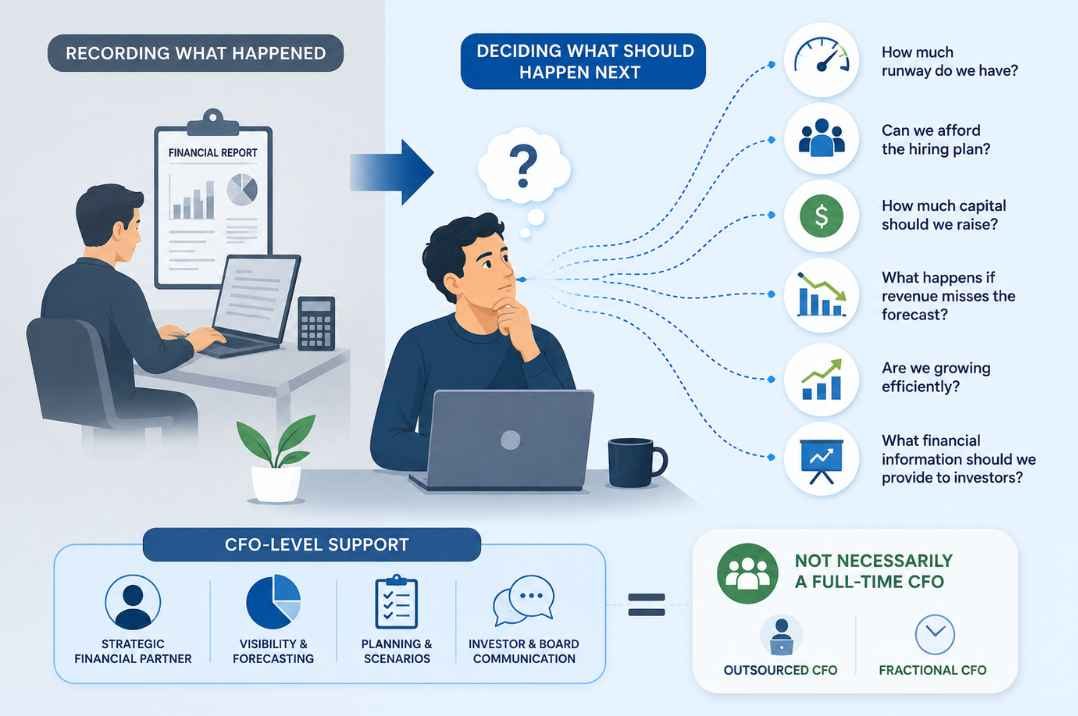
At some point, the financial questions become less about recording what happened and more about deciding what should happen next.
How much runway do we have?
Can we afford the hiring plan?
How much capital should we raise?
What happens if revenue misses the forecast?
Are we growing efficiently?
What financial information should we provide to investors?
When those questions become important to everyday management, the startup may need CFO-level support.
Importantly, that does not necessarily mean hiring a full-time CFO.
The Right Time Is Usually About Complexity, Not Revenue
There is no universal revenue threshold, funding round, or employee count at which every startup should hire a CFO.
A 30-person venture-backed SaaS company may have greater financial complexity than a much larger bootstrapped business.
The better question is:
Have the company’s financial decisions become important enough that founders need senior financial leadership?
Several signals can indicate that they have.
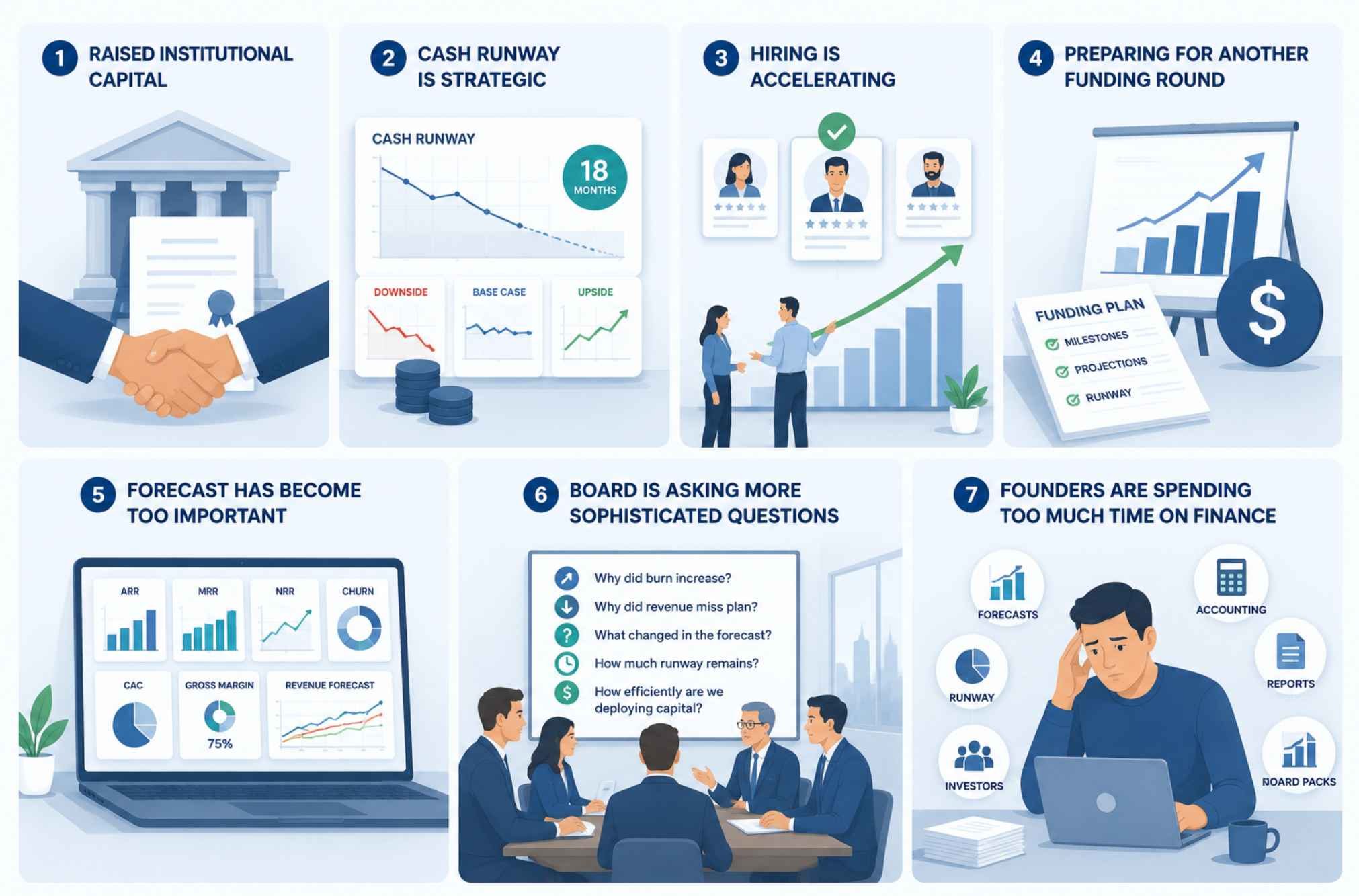
1. You Have Raised Institutional Capital
Once professional investors are involved, financial expectations usually increase.
Investors and board members may expect regular visibility into cash, burn, runway, budget performance, KPIs, and forecasts.
A CFO can help establish consistent reporting and give management a stronger financial framework for investor and board discussions.
2. Cash Runway Has Become a Strategic Issue
Knowing the current bank balance is not enough.
Growing startups need to understand how hiring, revenue, spending, and future financing will affect cash over the coming months.
A CFO can develop multiple scenarios rather than relying on a single runway estimate.
For example:
| Scenario | Business Assumption | CFO Focus |
|---|---|---|
| Downside | Revenue below plan | Preserve runway |
| Base Case | Performance on plan | Execute budget |
| Upside | Growth above plan | Evaluate acceleration |
This gives founders time to make decisions before liquidity becomes urgent.
3. Hiring Is Accelerating
For many startups, headcount is the largest expense.
As the company expands, hiring decisions should be connected directly to forecasting and runway.
A CFO can help management understand the full financial impact of new positions and answer questions such as:
Can we hire 15 people this quarter?
Should some hires be delayed?
What happens to runway if we accelerate engineering or sales hiring?
This turns headcount planning into part of the company’s broader capital strategy.
4. You Are Preparing for Another Funding Round
Startups should ideally prepare for fundraising well before they need the cash.
CFO-level support can help determine how much capital the company needs, what milestones that capital should fund, and how long the resulting runway should be.
A CFO can also support financial projections, investor metrics, due diligence, scenario modeling, and the financial components of the fundraising process.
5. Your Forecast Has Become Too Important for a Basic Spreadsheet
Early financial models are often relatively simple.
As the business grows, forecasting may need to incorporate revenue drivers, hiring schedules, customer behavior, departmental budgets, margins, and financing assumptions.
For a SaaS startup, this may also include ARR, MRR, NRR, churn, CAC, gross margin, and other operating metrics.
At this stage, management needs more than a budget.
It needs a forward-looking financial model that reflects how the business actually works.
6. The Board Is Asking More Sophisticated Questions
As investors become more involved, founders may face questions such as:
Why did burn increase?
Why did revenue miss plan?
What changed in the forecast?
How much runway remains?
How efficiently are we deploying capital?
A CFO helps founders move beyond presenting numbers to explaining what those numbers mean for the business.
7. Founders Are Spending Too Much Time Managing Finance
This is an important warning sign.
If the CEO is personally updating forecasts, calculating runway, coordinating accountants, preparing board financials, and answering investor finance questions, founder time may no longer be allocated efficiently.
The founder should remain deeply informed about finance.
But the founder should not necessarily have to operate the finance function.
Full-Time CFO or Outsourced CFO?
Needing CFO expertise does not automatically mean needing a full-time executive.
For many Seed, Series A, and growth-stage companies, an outsourced or fractional CFO can provide senior financial leadership without the cost and organizational commitment of immediately adding a permanent C-suite position.
As the company becomes larger and financial leadership requires continuous executive involvement, transitioning to a full-time CFO may make sense.
What Should a Startup CFO Actually Provide?
Founders should expect more than financial reports.
CFO-level support should typically improve visibility and decision-making across areas such as:
- Cash and runway management
- Financial forecasting
- Budgeting and FP&A
- Scenario planning
- Headcount planning
- KPI analysis
- Capital allocation
- Fundraising support
- Investor reporting
- Board reporting
The objective is to help management understand both where the company stands today and where its current decisions are taking it.
How ERB Proximo Supports Growing U.S. Startups
For startups operating in the United States, the transition from basic accounting to strategic finance does not always require building an entire internal finance department.
ERB Proximo can support growing companies with CFO-level leadership alongside broader capabilities in FP&A, controllership, accounting, forecasting, and management reporting.
This integrated structure is particularly useful when a startup needs strategic financial leadership but also needs the underlying finance operation to support it.
With operations in California and New York, ERB Proximo works with startups and growth companies navigating increasingly sophisticated financial requirements in major U.S. business and technology markets.
Frequently Asked Questions
At what stage does a startup need a CFO?
There is no single stage. CFO support often becomes valuable after institutional fundraising, during rapid hiring, before another financing round, or when forecasting and runway become strategically important.
Does a Seed startup need a CFO?
Some do, but often not full-time. A Seed-stage company with institutional investors, meaningful burn, or complex growth plans may benefit from outsourced CFO support.
Does a startup need a CFO if it already has an accountant?
Possibly. Accountants primarily focus on financial records and reporting. CFOs focus more heavily on forecasting, capital planning, runway, fundraising, and strategic financial decisions.
When should a startup hire a full-time CFO?
A full-time CFO becomes more appropriate when financial complexity and executive responsibilities require ongoing senior leadership and justify a permanent C-suite role.
The Best Time Is Before Finance Becomes a Problem
Startups should not wait for a cash crisis, difficult board meeting, or fundraising process to discover that they need stronger financial leadership.
The right time to introduce CFO support is usually when financial decisions begin materially influencing the company’s ability to grow, raise capital, and preserve runway.
At that point, a CFO is no longer simply a finance resource.
The CFO becomes part of the company’s decision-making infrastructure.