
“How do I set up proper accounting for my new US startup?” This is a common question among entrepreneurs. ERB Proximo has compiled this guide to walk founders through the essentials of US startup accounting. Whether you’re launching a Delaware C-corp, managing payroll, or just keeping your books straight, the steps below will help you build a solid financial foundation. We’ll cover choosing a structure, registering with the IRS, establishing bookkeeping, and ongoing compliance – all in plain English for non-US founders.
Who Is This Guide For?
This guide is designed for startup founders, technology entrepreneurs, and international businesses establishing a U.S. entity or expanding into the American market.; in particular, it will be beneficial to companies with overseas ownership that are entering the market in the U.S. ERB Proximo, as a finance outsourcing organization, supports a wide range of Israeli start-up firms in establishing a U.S.-based entity to meet all of their accounting compliance needs. If you are a CEO or CFO who is establishing an operation in the United States, or if you are an investor considering what is necessary to operate in the U.S. market, then find the steps to be taken to establish an operation and the best practices for that purpose within this guide.
Choosing Your Business Structure & Location
The first step is choosing the right legal structure and state for your business. Common U.S. business entities include LLCs, partnerships, C corporations, and S corporations. According to the IRS, your business structure determines which tax returns you must file. Many high-growth startups choose to incorporate as Delaware C corporations because of the state’s investor-friendly corporate laws.
Delaware is home to more than 2 million registered businesses, including over 66% of Fortune 500 companies. After incorporation, businesses must appoint a Registered Agent, obtain an Employer Identification Number (EIN) from the IRS, and keep ownership information up to date. Most businesses need an EIN, even if they have no employees.
Building an Accounting System That Scales
Once your company is incorporated and has an EIN, the next priority is building a reliable accounting system. Start by opening a dedicated U.S. business bank account to separate business and personal finances.
Next, choose between cash and accrual accounting. Most startups planning to raise investment prefer accrual accounting because it aligns with Generally Accepted Accounting Principles (GAAP) and provides more accurate financial reporting.
Set up a Chart of Accounts (COA) to track assets, liabilities, income, and expenses, and implement a double-entry bookkeeping system, which the IRS recommends for greater accuracy and stronger financial controls.
As your startup grows, professional financial support becomes increasingly valuable. Firms such as ERB Proximo provide outsourced CFO and accounting services, helping founders manage bookkeeping, financial reporting, tax compliance, and investor-ready financial statements. Establishing these systems from day one creates a strong financial foundation and helps avoid costly mistakes later.
Key Steps to Launch Your Startup Accounting
To summarize, here are the critical action items after forming your US startup entity:
- Form Your Entity: Decide on LLC vs. C-Corp (Delaware is a popular choice) and register with the state. Obtain a Delaware Registered Agent if you incorporate in DE.
- Get an EIN from the IRS: Apply on IRS.gov (Form SS-4) to obtain your Employer Identification Number. Use it on all federal tax filings and for payroll reporting.
- Open a US Bank Account: Using your incorporation papers and EIN, open a dedicated business account in the US. This separates business and personal funds.
- Choose Accounting Method & Software: Decide between cash vs. accrual accounting (accrual is GAAP-aligned). Set up a double-entry bookkeeping system (many packages are available) to track assets, liabilities, equity, income, and expenses.
- Set Up Payroll and Withholding: If you hire US employees or pay contractors, register for payroll tax withholding. Have each employee complete Form I‑9 and Form W‑4. File Form 941 quarterly to report income tax and FICA withholdings. File Form 940 annually for unemployment tax. Issue Form W-2 (wages) and Form 1099 (contractors) as required.
- Register for State Taxes/Licenses: Check your state government site for sales tax permits, state income tax registration, and any professional licenses. For Delaware corps, file the Annual Report and pay franchise tax by March 1 (min $175). If you operate in other states, comply with their sales tax and employer taxes on time.
- Maintain Books and Reports: Keep accurate financial records. The IRS requires retention of tax-related documents (like receipts and payroll records) for several years. The SBA’s guide notes that properly tracked financials allow cost-benefit analyses and budgeting. Use monthly or quarterly closings to reconcile bank accounts and prepare profit/loss statements.
- Plan for Taxes: Identify which federal tax forms you must file. For example, a US C-corporation files Form 1120 each year, while an LLC (with 2+ members) files Form 1065. Foreign owners should note that a 25%-foreign-owned US corporation must file Form 5472 for any related-party transactions.
- Get Professional Review: Before any fundraising or public filings, ensure your financial statements follow US standards. Consider an audit or CPA review. Firms like ERB Proximo provide ongoing financial reporting and investor-ready reports.
Startup Accounting Roadmap
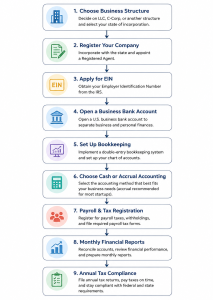
| Step | Action | Why It Matters |
| 1 | Choose your business entity | Determines tax and reporting requirements |
| 2 | Obtain an EIN | Required for banking, payroll, and tax filings |
| 3 | Open a business bank account | Separates business and personal finances |
| 4 | Choose an accounting method | Supports accurate financial reporting and GAAP compliance |
| 5 | Set up bookkeeping | Tracks income, expenses, assets, and liabilities |
| 6 | Register for payroll taxes | Required before hiring employees and processing payroll |
| 7 | Register for state taxes and licenses | Ensures compliance with state-specific requirements |
| 8 | Plan for tax compliance | Helps meet federal and state filing deadlines |
| 9 | Seek professional financial support | Improves compliance, reporting, and investor readiness |
Startup Accounting Essentials
- Legal & Tax Setup: Choose entity type wisely and register (Delaware C-Corps are common). Obtain an EIN from the IRS.
- Accounting System: Start with a solid bookkeeping system. Track a balance sheet and profit & loss; double-entry accrual accounting is recommended.
- Payroll Compliance: If you have US employees, withhold taxes (Forms I‑9, W‑4) and file Form 941 quarterly. Also file Form 940 for unemployment each year.
- State Requirements: Always check the official state website for local rules. If Delaware, remember the annual report and franchise tax (minimum $175) by March 1. Other states have their own sales tax and employer tax rules.
- Professional Help: Don’t go it alone. Hire or consult a US CPA/CFO. The SBA even suggests using professional accounting services as you grow. Expert guidance (e.g. from ERB Proximo) can prevent costly errors.
- Recordkeeping: Maintain thorough records and invoices. Good recordkeeping not only satisfies IRS rules, but also provides data for budgeting and investor reports.
Summary of Essential Actions
Building a strong accounting foundation from day one helps startups stay compliant, improve financial visibility, and prepare for future growth. By choosing the right business structure, implementing accurate bookkeeping, understanding tax obligations, and working with experienced professionals such as ERB Proximo, founders can focus on growing their business while maintaining full financial compliance.
Frequently Asked Questions
Do I need a US accountant or can I do it myself? You can start by managing simple bookkeeping with software, but as the IRS notes, consider getting help from a CPA or CFO especially as you grow. Professionals ensure you meet all US-GAAP and tax requirements, and can save time (and money) by avoiding mistakes.
Which accounting method should my startup use? Startups often choose accrual basis accounting, as it matches revenues to expenses and is preferred for GAAP reporting. Cash basis is simpler but may not reflect your true financial position if you carry inventory or defer payments.
What taxes must my startup pay? Your federal tax obligations depend on your entity. A C-corp files Form 1120 for income tax, an LLC or partnership files Form 1065, and an S-corp files Form 1120S. All businesses with payroll file Form 941 quarterly (and 940 annually) for employment taxes. Delaware corps also pay an annual franchise tax and report by March 1.
What is Form 5472 and do I need it? Form 5472 is an IRS information return for US corporations with 25% or greater foreign ownership. If your US startup has a foreign owner and has reportable related-party transactions (like loans or asset transfers with the parent company), you must file Form 5472. This often surprises first-time foreign entrepreneurs.
Why incorporate in Delaware instead of my home state? Delaware offers flexible corporate laws, a specialist chancery court, and privacy for owners. Many investors expect Delaware C-corps. However, you will have to handle Delaware’s annual report and franchise tax (min. $175). Compare that to local requirements in your state of operation. For a business with physical presence in another state, you may need to qualify (foreign register) there as well.
When should I hire a CFO or advisory service? As soon as your financial transactions become non-trivial. If you have revenue, investors, or employees in the US, it’s wise to engage a professional early. The costs of failing to file correct reports or missing tax deadlines can far exceed the expense of expert guidance. ERB Proximo, for example, advises many Israeli startups on exactly these issues to ensure compliance and financial clarity.