
As startups expand, their corporate structure often becomes more complex before their finance function does.
A company that began as a single corporation may eventually operate through a parent company, U.S. subsidiaries, international subsidiaries, intellectual property entities, or entities created to support specific markets and operations. Each entity may have its own bank accounts, employees, vendors, tax requirements, currencies, accounting records, and local advisors.
From a legal perspective, these entities may be separate organizations. From a management perspective, however, founders still need to answer one fundamental question:
How is the business performing as a whole?
That is where CFO leadership becomes increasingly important.
Managing multiple entities is not simply a matter of adding together several sets of financial statements. The CFO needs to create a financial architecture that preserves entity-level accuracy while giving management a reliable consolidated view of the organization. That includes defining accounting policies, structuring intercompany activity, coordinating financial closes, managing cash across the group, establishing reporting standards, overseeing compliance calendars, and building forecasts that reflect how the entire organization operates.
For a startup expanding across the United States or internationally, the objective is not necessarily to centralize every financial activity. Different jurisdictions may require different providers, processes, and expertise.
The objective is to make those activities operate as one coordinated financial system.
Multiple Legal Entities Need One Financial Architecture
The first challenge is structural.
Imagine a technology company with a Delaware parent corporation, an operating subsidiary in California, a European development entity, and another subsidiary supporting a new market. Each entity may legitimately require different accounting, payroll, banking, tax, and compliance processes.
Without CFO-level coordination, those differences can gradually create financial fragmentation.
One entity may close its books on the fifth business day while another closes on the twentieth. One accounting team may classify expenses differently from another. Intercompany transactions may appear in one company’s records but not yet in the counterparty’s. Department structures may differ between systems. Management reports may use different definitions of revenue or operating expenses.
Individually, each set of books may appear reasonable.
Collectively, management may struggle to obtain a reliable picture of the group.
A CFO establishes the architecture connecting these entities. This may include a common chart-of-accounts framework, standardized management categories, reporting calendars, accounting policies, approval procedures, intercompany processes, and consistent definitions for financial and operating KPIs.
The goal is not necessarily to make every local accounting system identical. Local requirements can differ significantly.
Instead, the CFO determines how local financial information will ultimately map into a common management framework.
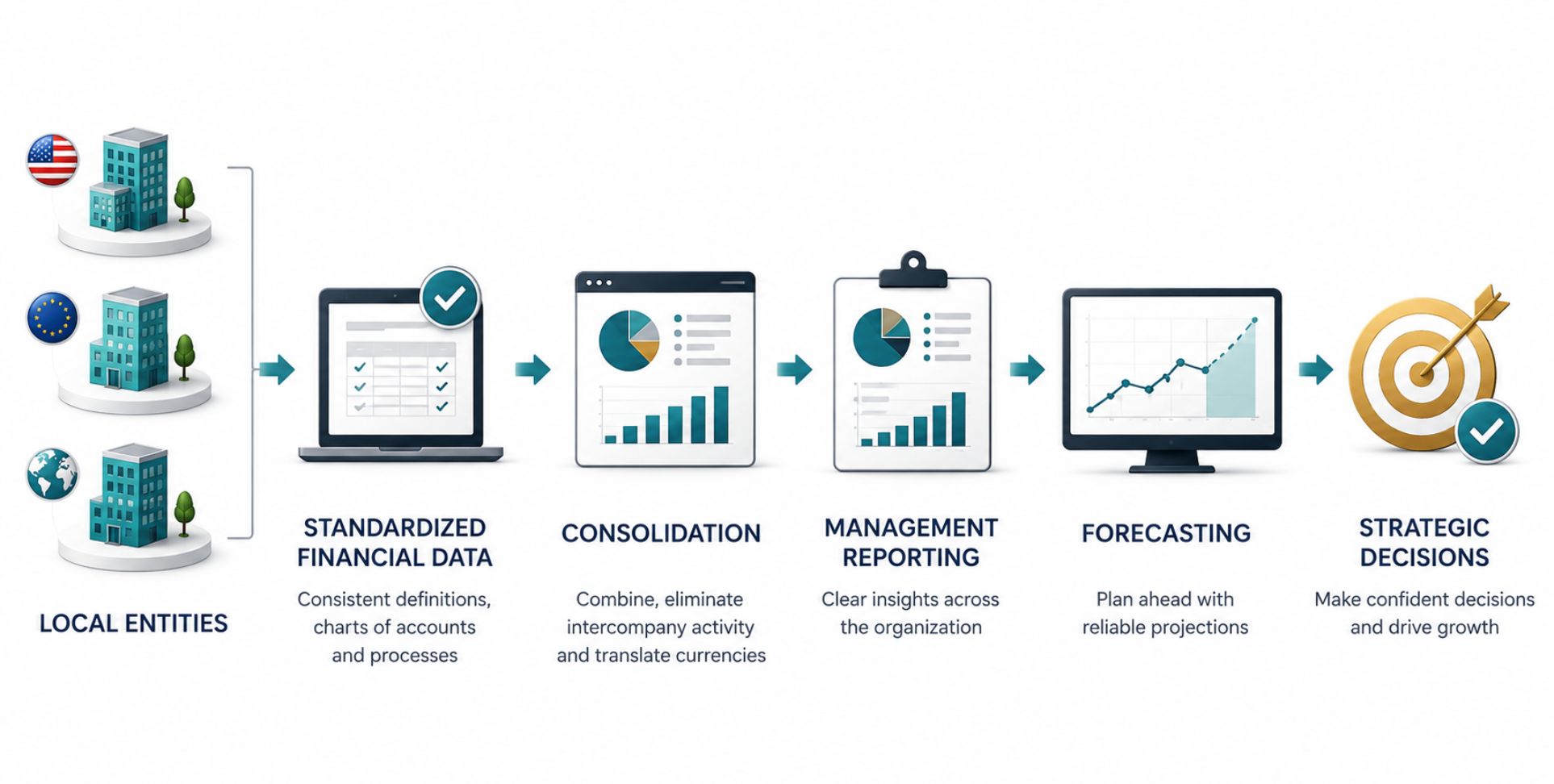
Conceptually, the structure becomes:
Local Entities → Standardized Financial Data → Consolidation → Management Reporting → Forecasting → Strategic Decisions
That structure becomes increasingly valuable as the organization grows because management no longer needs to reconstruct the group financial picture every time it prepares a board report, forecast, or financing analysis.
Intercompany Transactions Require More Discipline Than They Initially Appear To
Intercompany activity is often one of the first areas where a multi-entity structure becomes financially complicated.
One entity may pay expenses on behalf of another. Employees located in one subsidiary may provide services to another part of the organization. A parent company may fund subsidiaries. Technology, intellectual property, administrative support, or shared services may create transactions between entities.
These arrangements can have accounting, tax, legal, and transfer-pricing implications. The appropriate treatment should therefore be determined with qualified accounting, tax, and legal professionals based on the company’s specific structure and jurisdictions.
From a CFO perspective, however, there is another important requirement: intercompany activity needs to be visible, structured, and reconcilable.
Suppose the parent company records a $300,000 receivable from a subsidiary, while the subsidiary records only $250,000 as payable to the parent. At an entity level, both accounting teams may continue closing their books. At consolidation, however, the $50,000 difference becomes a problem that Finance must investigate.
Multiply that situation across several entities, currencies, expense allocations, and months, and reconciliation can become a significant operational burden.
A CFO establishes processes designed to prevent those differences from accumulating. Intercompany balances can be reconciled on a recurring schedule, transactions can use consistent references and counterparties, and responsibility for resolving discrepancies can be clearly assigned.
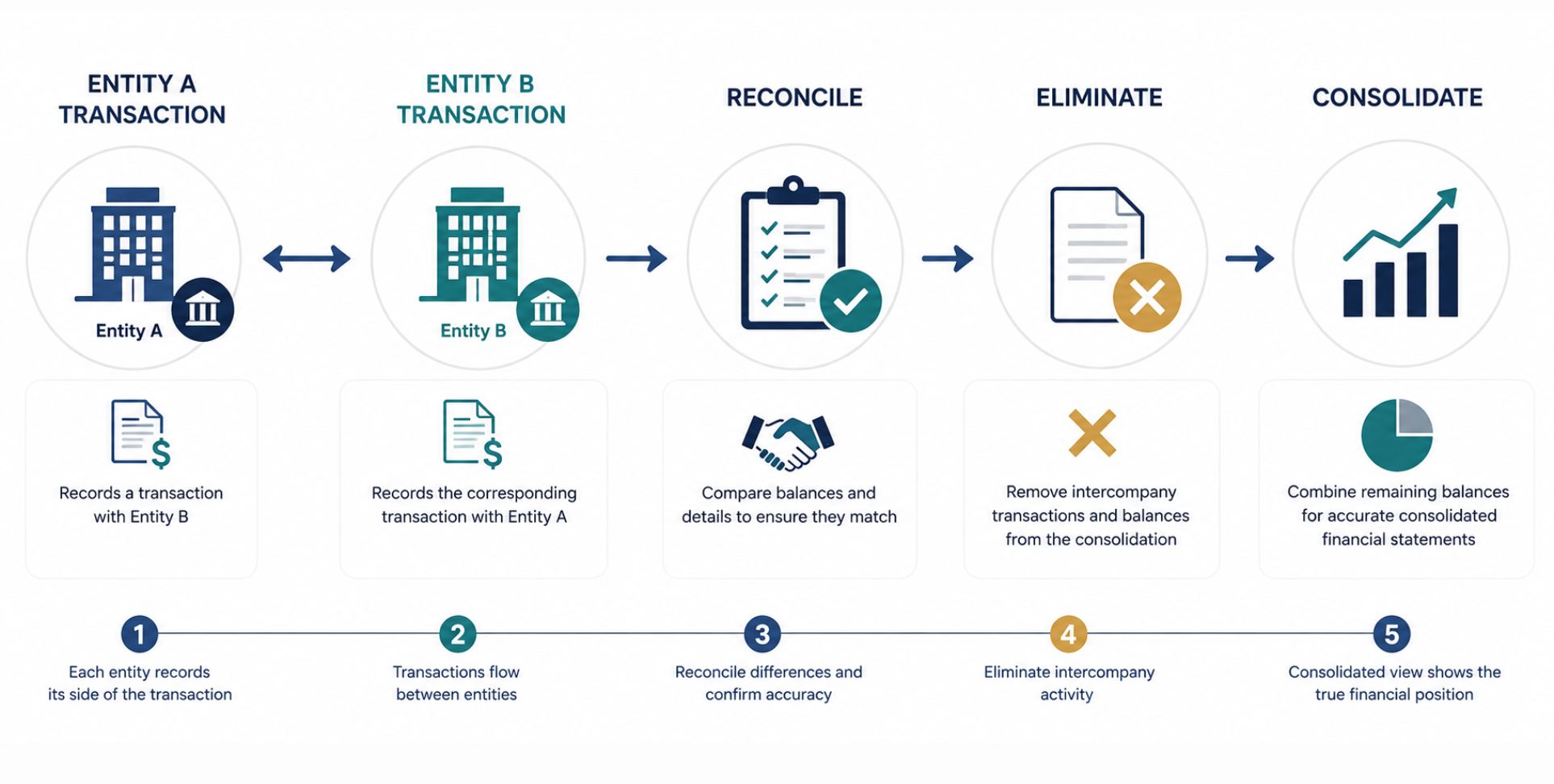
The principle is simple:
Entity A Transaction ↔ Entity B Transaction → Reconcile → Eliminate → Consolidate
The earlier this discipline is established, the easier it generally becomes to scale the financial organization.
Consolidated Reporting Must Show Both the Group and the Businesses Inside It
Founders need consolidated financial statements because they need to understand the economic performance of the entire organization.
But consolidation alone is not enough.
A consolidated P&L may show that the company spent $4 million on R&D during the year. Management may still need to understand how much was spent by the U.S. organization, how much by an international development center, whether spending is above budget, and how the distribution is expected to change as the company scales.
The CFO therefore needs to create two complementary views:
Entity-level visibility and group-level visibility.
The entity view helps Finance understand local operations, cash requirements, expenses, tax coordination, and performance.
The consolidated view helps founders, executives, boards, and investors understand the company as a whole.
For management reporting, the CFO may add additional dimensions beyond legal entity. Financial information can potentially be analyzed by department, geography, product, business unit, or another dimension relevant to management.
This distinction matters because legal structure and management structure are not always the same.
A SaaS company may have engineers employed by three different entities but want to evaluate Engineering as one global department. Similarly, its U.S. subsidiary may support several products, while management needs product-level profitability or investment visibility.
A sophisticated multi-entity finance function therefore asks two different questions:
Where was the transaction legally recorded?
and
How should management understand the economic activity?
The CFO helps make both views available without confusing one for the other.
The Monthly Close Becomes a Coordinated Group Process
In a single-entity startup, closing the books can already require coordination across accounts payable, payroll, revenue, banking, and accounting.
With multiple entities, the dependencies multiply.
A delay in one subsidiary can delay consolidated reporting for the entire organization. Unreconciled intercompany balances can prevent consolidation. Currency adjustments may be required. Local accountants may work according to different calendars. Payroll information may arrive at different times. Revenue or expense classifications may need adjustment before group reporting is complete.
The CFO therefore establishes a group close calendar.
Each finance team or service provider should understand what information is required, when it is due, and which activities depend on its completion. Material issues should be escalated rather than discovered at the end of the process.
The financial operating rhythm might look like:
Local Close → Intercompany Reconciliation → Review & Adjustments → Consolidation → Variance Analysis → Forecast Update → Management Reporting
As the company grows, this cadence becomes part of its financial infrastructure.
The value extends beyond producing reports faster. A consistent close gives management a dependable point each month when historical performance is converted into updated financial insight.
That makes the close the beginning of financial analysis rather than the end of accounting.
Cash Management Becomes a Group-Level Capital Allocation Question
A company with multiple entities can have substantial cash at the consolidated level while individual subsidiaries face very different liquidity positions.
One entity may collect most customer revenue while another employs a significant portion of the workforce. A parent company may hold financing proceeds while subsidiaries require recurring funding. Different currencies can create additional considerations.
The CFO needs visibility into cash across the entire group.
That means understanding where cash is held, which entities generate cash, which consume it, what contractual or regulatory restrictions may apply, and when subsidiaries may require additional funding.
The objective is not simply to produce a consolidated bank balance.
Finance should be able to forecast cash requirements by entity and for the group.
For example:
| Entity | Primary Financial Role | CFO Focus |
|---|---|---|
| Parent Company | Capital and corporate functions | Group liquidity |
| U.S. Operating Entity | Revenue and commercial activity | Collections and operating cash |
| Development Subsidiary | R&D and payroll | Funding requirements |
| New Market Entity | Expansion investment | Burn and milestone tracking |
The specific structure will differ by company, but the management question remains consistent:
Where is cash today, where will it be needed tomorrow, and how does that affect the company’s consolidated runway?
Moving funds between entities can have legal, tax, banking, currency, and regulatory implications. Those matters should be evaluated with the appropriate specialists.
The CFO’s responsibility is to make sure management sees the financial need early enough to act deliberately.
Forecasting Needs to Work From the Bottom Up and the Top Down
Multi-entity forecasting can become unreliable if Finance simply takes last year’s consolidated results and applies growth assumptions.
Different entities often have fundamentally different economic drivers.
A U.S. commercial entity may be driven by sales hiring, customer acquisition, bookings, and collections. An international R&D subsidiary may be driven primarily by engineering headcount and compensation. A new-market subsidiary may have substantial initial costs with limited near-term revenue.
Each component therefore needs assumptions that reflect how it actually operates.
The CFO can build entity-level operating forecasts and connect them to a consolidated financial model.
At the same time, management needs a top-down view.
If the board approves a maximum annual burn or a particular runway objective, entity budgets cannot be developed independently without considering those group constraints.
This creates a two-directional planning process:
Entity Plans → Consolidated Forecast
and
Corporate Strategy → Capital Constraints → Entity Budgets
The CFO sits at the intersection.
If one subsidiary proposes accelerating hiring, Finance can evaluate not only the local budget impact but also the effect on consolidated burn and runway. If a U.S. sales organization expects faster growth, the CFO can determine whether supporting functions in other entities need additional capacity.
This is where multi-entity financial management moves beyond consolidation.
The CFO is not merely combining companies.
The CFO is helping management allocate resources across them.
Currency Adds Another Dimension to Financial Performance
International structures can introduce multiple currencies into accounting, forecasting, and cash management.
A company may raise capital and report to investors in U.S. dollars while paying a significant portion of its employees and vendors in other currencies. Exchange-rate movements can therefore change reported expenses and cash requirements even when local operating activity remains unchanged.
For management, this creates an important analytical distinction.
Did R&D expense increase because the company hired more engineers?
Or did reported expense increase partly because of currency movement?
A CFO can help separate operational performance from foreign-exchange effects where that distinction is meaningful.
Forecasting should also consider the currency in which future expenses and revenue are expected to occur. If a substantial portion of the cost base is denominated outside the company’s reporting currency, changes in exchange rates can affect projected burn and runway.
Foreign-exchange strategy can involve financial, banking, tax, and risk-management considerations beyond ordinary FP&A. Where appropriate, companies should work with relevant specialists.
The CFO’s role is to make sure currency exposure is visible within the broader financial model rather than appearing as an unexpected variance after the fact.
Compliance Becomes a Calendar, Not a Single Deadline
Every additional entity can introduce another set of recurring obligations.
Depending on jurisdiction and activity, these may involve corporate filings, tax returns, payroll filings, statutory accounts, franchise taxes, local registrations, audits, or other requirements.
A CFO should not attempt to replace the lawyers, tax professionals, payroll specialists, and local accountants responsible for specialized compliance work.
Instead, Finance needs to coordinate the overall compliance architecture.
A multi-entity organization benefits from a centralized calendar showing the major obligations associated with each entity, responsible internal and external parties, required financial information, and relevant deadlines.
That creates accountability.
More importantly, it connects compliance with financial operations.
A tax filing may depend on the books being closed. A statutory report may require local accounting information. Payroll filings depend on employee data. Corporate obligations may require coordination with legal counsel.
When these processes operate independently, founders can find themselves managing a network of advisors personally.
The CFO helps turn that network into a coordinated financial ecosystem.
The CFO Needs to Preserve Local Accountability Without Creating Finance Silos
Centralization is useful, but not everything should necessarily be centralized.
A local finance provider may understand jurisdiction-specific requirements better than the corporate finance team. Local payroll may require specialist systems. Tax compliance may need local expertise.
The CFO therefore needs to distinguish between local execution and central financial governance.
Local teams can execute activities that require local expertise.
Corporate Finance establishes the framework in which those activities operate.
That framework may define reporting standards, deadlines, accounting policies, budget ownership, approval thresholds, intercompany procedures, KPI definitions, and consolidation requirements.
A useful operating model is:
Local Expertise + Central Standards + Consolidated Visibility
This avoids two extremes.
In a completely decentralized model, every entity can become a financial island.
In an excessively centralized model, corporate Finance may attempt to control processes it does not understand well enough locally.
Strong CFO leadership creates coordination without eliminating the expertise required in individual jurisdictions.
Multi-Entity Reporting Becomes Critical During Fundraising and Due Diligence
Corporate complexity becomes particularly visible during a financing round, acquisition, audit, or other due diligence process.
Investors may want to understand not only consolidated financial performance but also how the corporate group is structured, where employees and revenue sit, how entities are funded, whether intercompany balances reconcile, and whether significant obligations have been addressed.
If management needs several weeks simply to reconcile the relationship between its entities, diligence becomes more difficult.
A CFO can create readiness long before a transaction begins.
That includes maintaining reliable entity-level books, reconciled intercompany accounts, consolidated financial reporting, cash visibility, documented financial processes, and forecasts that correspond with the actual corporate structure.
The value is not limited to diligence.
The same infrastructure improves monthly management decisions.
This is a recurring theme in sophisticated finance organizations: the financial discipline that prepares a company for investors is often the same discipline that helps founders operate it more effectively.
When Does a Startup Need CFO-Level Multi-Entity Management?
A second legal entity does not automatically mean a company needs a full-time CFO.
But certain developments can indicate that the financial structure requires more senior coordination.
The need becomes more significant when entities operate in multiple jurisdictions, intercompany transactions become frequent, consolidated reporting takes too long, management lacks entity-level cash visibility, different accounting teams use inconsistent approaches, international hiring expands, investor reporting becomes more sophisticated, or founders find themselves coordinating multiple accountants, payroll providers, and tax advisors personally.
At that point, the problem is no longer bookkeeping.
It is financial architecture.
An outsourced CFO can be particularly useful for companies that have reached this level of complexity but do not yet require a permanent senior finance executive.
The objective is to establish the structure before the organization becomes substantially more difficult to untangle.
How ERB Proximo Supports Multi-Entity and Multinational Companies
For companies operating across multiple entities, the greatest financial challenge is often not any individual accounting or reporting task. It is making all of those tasks work together.
ERB Proximo supports U.S. startups, growth companies, and multinational organizations through an integrated financial model that includes outsourced CFO services, accounting, controllership, bookkeeping, payroll, FP&A, forecasting, U.S. tax compliance, entity setup, and financial operations for multinational companies.
For businesses with U.S. and international operations, this can include establishing consolidated management reporting, coordinating accounting across entities, developing cash and runway forecasts, supporting intercompany financial processes, creating entity and group budgets, and building financial models that give founders a unified view of the organization.
The integrated approach becomes particularly valuable when a company has several providers or jurisdictions involved. Rather than allowing accounting, payroll, compliance, and strategic finance to evolve independently, CFO leadership can connect them within a common reporting and planning architecture.
With a U.S. presence in California and New York, ERB Proximo supports companies building and scaling operations across major U.S. business and technology ecosystems.
The objective is straightforward:
Multiple entities should increase the company’s operating reach — not reduce management’s financial visibility.
Frequently Asked Questions
What does multi-entity financial management mean?
It refers to managing financial operations across two or more legal entities while maintaining accurate entity-level accounting and providing management with a reliable consolidated view of the overall organization.
How does a CFO consolidate multiple entities?
The process generally involves reliable local accounting, standardized reporting, intercompany reconciliation, appropriate consolidation adjustments and eliminations, and consolidated financial reporting. The specific accounting treatment depends on the corporate structure and applicable accounting requirements.
Why are intercompany reconciliations important?
Transactions between related entities should generally correspond across both sets of records. Regular reconciliation helps identify differences before they accumulate and supports more reliable consolidation.
How does a CFO manage cash across subsidiaries?
A CFO can establish entity-level cash forecasts and combine them into a group liquidity model. This allows management to anticipate funding requirements and understand how individual subsidiaries affect consolidated runway.
Can one CFO manage U.S. and international entities?
Yes, CFO leadership can coordinate the group financial framework while working with local accountants, tax professionals, payroll specialists, attorneys, and other experts where jurisdiction-specific expertise is required.
Does a startup need separate accounting for every legal entity?
Separate legal entities generally require financial records appropriate to their structure and obligations. The exact accounting and reporting requirements should be determined with qualified accounting and tax professionals.
Can an outsourced CFO manage a multi-entity startup?
Yes. Outsourced CFO support can be particularly relevant when a company requires sophisticated consolidation, forecasting, cash management, and financial coordination but does not yet need a full-time executive CFO.
The Goal Is One Financial View of a Complex Organization
A successful multi-entity finance function does something that appears contradictory.
It preserves the financial integrity of every individual entity while making the legal complexity almost invisible to management.
Founders should be able to move from the highest level of the organization down into the detail:
How is the group performing?
Which entity is driving the variance?
Which department or activity explains it?
How does it affect cash?
What does it change in the forecast?
Does management need to act?
When those questions can be answered quickly and consistently, the corporate structure is no longer controlling the finance function.
The finance function is controlling the complexity.
And that is ultimately the CFO’s role in a multi-entity organization: not simply consolidating numbers from several companies, but creating one financial system through which management can understand and manage the entire business.