
The HealthTech industry is transforming how healthcare is delivered, managed, and experienced. From AI-powered diagnostics and telehealth platforms to remote patient monitoring and digital therapeutics, technology companies are developing new solutions for patients, providers, and healthcare organizations.
Yet building a successful HealthTech company requires more than technological innovation and clinical expertise. Founders must navigate complex revenue models, long enterprise sales cycles, regulatory requirements, reimbursement uncertainty, and significant investment in product development.
These challenges make financial leadership particularly important.
A HealthTech CFO helps healthcare technology companies connect financial strategy with operational execution, supporting cash flow management, fundraising, financial planning, and sustainable growth.
For startups that are not ready to hire a full-time finance executive, an outsourced or fractional HealthTech CFO can provide strategic expertise while allowing the company to allocate resources toward product development and market expansion.
What Is a HealthTech CFO?
A HealthTech CFO is a financial executive who supports companies developing technology products and services for the healthcare industry.
Unlike a traditional finance leader focused primarily on accounting and financial reporting, a HealthTech CFO must understand the relationship between financial performance, healthcare market dynamics, technology development, and commercial adoption.
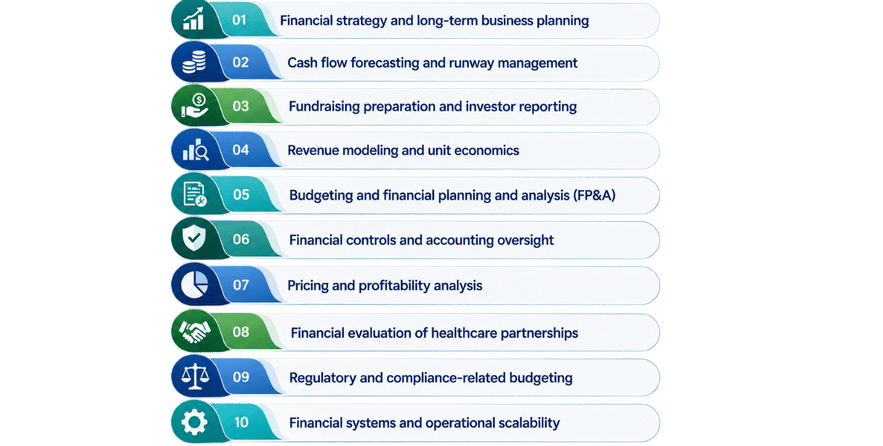
Responsibilities typically include:
- Financial strategy and long-term business planning
- Cash flow forecasting and runway management
- Fundraising preparation and investor reporting
- Revenue modeling and unit economics
- Budgeting and financial planning and analysis (FP&A)
- Financial controls and accounting oversight
- Pricing and profitability analysis
- Financial evaluation of healthcare partnerships
- Regulatory and compliance-related budgeting
- Financial systems and operational scalability
The specific responsibilities depend on the company’s business model.
For example, a digital health SaaS company selling to hospitals may require sophisticated enterprise contract forecasting, while a remote patient monitoring company may need additional visibility into device costs, reimbursement arrangements, and patient engagement economics.
A qualified HealthTech CFO helps translate these business realities into financial decisions.
Why HealthTech Startups Need Specialized CFO Expertise
Healthcare technology companies operate at the intersection of two complex industries: technology and healthcare.
Technology startups often prioritize rapid product development, customer acquisition, and scalable revenue models.
Healthcare businesses, meanwhile, may face extended procurement processes, regulatory oversight, clinical validation requirements, and complicated payment arrangements.
HealthTech companies frequently encounter both sets of challenges simultaneously.
A promising product may require substantial investment before generating meaningful revenue. A contract with a large healthcare organization may involve lengthy negotiations, security assessments, and implementation requirements.
In certain business models, reimbursement rules or payer relationships may directly influence revenue generation.
These factors create financial uncertainty that traditional startup forecasting may not fully capture.
A specialized CFO helps management understand the financial implications of commercial delays, development milestones, regulatory obligations, and changing market conditions.
1. Financial Planning for Different HealthTech Business Models
Not all HealthTech companies generate revenue in the same way.
Understanding the business model is one of the first responsibilities of a HealthTech CFO.
| HealthTech business model | Typical revenue structure | Key financial considerations |
|---|---|---|
| Digital Health SaaS | Subscription or enterprise licensing | ARR, churn, implementation costs, gross margin |
| Telehealth Platforms | Visit-based fees, subscriptions, or enterprise contracts | Provider costs, utilization, payment collection |
| Remote Patient Monitoring | Device, service, or contractual payments | Device economics, eligible services, collection timing |
| AI Healthcare Software | Software licenses, usage-based pricing, enterprise agreements | Computing costs, development expenses, sales cycles |
| Digital Therapeutics | Contracts, product sales, or reimbursement-dependent arrangements | Evidence generation, commercialization costs, payer access |
| Healthcare Data Platforms | Subscription, licensing, or service agreements | Data infrastructure, security costs, contract profitability |
A CFO should develop financial models that reflect how each company actually earns revenue.
For example, a company selling software to hospital systems may have relatively few customers but large contract values.
A consumer-facing health application may depend on high user volumes, conversion rates, and retention.
Applying the same forecasting assumptions to both businesses would create misleading financial expectations.
Financial models should account for customer acquisition, contract structures, implementation timelines, operating costs, and the timing of cash collections.
2. Cash Runway and Burn Rate Management
Cash runway is one of the most important financial indicators for an early-stage HealthTech startup.
Many companies must invest in technology, product validation, security infrastructure, and commercial development before reaching predictable revenue.
A HealthTech CFO helps founders understand how long existing capital can support operations and how strategic decisions affect future liquidity.
A comprehensive cash forecast should incorporate:
- Product development: Engineering, software development, testing, and infrastructure expenses.
- Clinical or technical validation: Research, studies, evaluations, and related professional services where applicable.
- Regulatory planning: External advisers, submissions, quality systems, and other relevant requirements.
- Sales and commercialization: Business development, marketing, procurement cycles, and implementation costs.
- Personnel: Compensation, benefits, recruitment, and planned organizational expansion.
- Technology operations: Hosting, data processing, cybersecurity, and third-party software.
- Revenue collections: Expected customer payments, contract milestones, and reimbursement-related timing where relevant.
A useful forecast should extend beyond a single projected outcome.
For example, management may need to evaluate what happens if a major hospital contract closes six months later than expected or if additional product development is required before launch.
Scenario planning helps founders identify potential funding gaps before they become urgent.
 3. Healthcare Reimbursement and Revenue Forecasting
Revenue forecasting can be particularly complex for HealthTech companies whose business models involve healthcare reimbursement.
Some companies sell directly to providers or health systems, while others depend on payer contracts, reimbursement arrangements, or healthcare service delivery.
These distinctions are financially significant.
For example, certain remote patient monitoring services may qualify for Medicare payment when applicable coverage, documentation, billing, and service requirements are satisfied.
However, the availability of a billing code does not automatically establish that every product, service, provider, or patient interaction is reimbursable.
A HealthTech CFO should work with appropriate reimbursement and compliance specialists to understand how payment requirements influence revenue assumptions.
Important financial questions include:
- Who is contractually responsible for paying the company?
- Does revenue depend on patient eligibility or service utilization?
- What documentation or performance conditions affect payment?
- How long does it take to collect revenue?
- What contractual deductions or collection risks exist?
- How would changes in reimbursement arrangements affect profitability?
These questions help management distinguish potential market demand from realistically collectible revenue.
For companies selling exclusively through enterprise software agreements, the focus may instead be on contract values, implementation fees, renewals, and customer concentration.
The financial model must reflect the actual commercial arrangement.
 4. Fundraising and Investor Reporting for HealthTech Startups
HealthTech startups often require significant capital to finance development, market entry, and expansion.
A CFO plays a central role in preparing the financial information investors need to evaluate the business.
This includes developing financial forecasts, presenting capital requirements, analyzing business performance, and supporting financial due diligence.
For HealthTech companies, investors may examine financial performance alongside product adoption, commercial partnerships, regulatory milestones, and clinical evidence where relevant.
A CFO helps connect these elements into a coherent financial narrative.
A fundraising-ready financial model should explain:
- Current cash position and projected runway
- Historical operating expenses
- Revenue assumptions and commercial milestones
- Customer acquisition and implementation costs
- Hiring and product development plans
- Gross margin and unit economics
- Capital requirements and use of funds
- Financial scenarios and key risks
The objective is not to present the most optimistic forecast.
It is to demonstrate that management understands the company’s financial drivers, assumptions, and potential challenges.
 5. Regulatory Compliance and Financial Risk Planning
Regulatory considerations can have a material financial impact on HealthTech companies.
Depending on the product and its intended use, a company may need to evaluate FDA requirements, healthcare privacy obligations, cybersecurity standards, or contractual compliance requirements.
Not every HealthTech application is regulated as a medical device.
For example, the FDA distinguishes between certain software functions that meet the definition of a medical device and functions that fall outside that definition.
A HealthTech CFO does not replace regulatory or legal specialists.
Instead, the CFO helps translate identified obligations into budgets, timelines, financial controls, and risk scenarios.
Financial planning may include the costs of:
- Regulatory and legal advisers
- Quality management systems
- Product testing and validation
- Security assessments
- Compliance-related personnel
- External audits or independent reviews
- Cybersecurity infrastructure
- Insurance and risk management
For businesses handling protected health information, HIPAA requirements may also affect operational processes and vendor relationships, depending on whether the organization is a covered entity or business associate.
A CFO should coordinate with qualified privacy and security professionals to ensure relevant costs and contractual obligations are incorporated into financial planning.
6. HealthTech Unit Economics and Profitability Analysis
Revenue growth alone does not determine whether a HealthTech business model is financially sustainable.
A company may acquire customers rapidly while facing high implementation expenses, clinical service costs, or technology infrastructure requirements.
A HealthTech CFO evaluates the economics of serving customers and identifies the conditions required for profitable growth.
Important metrics may include:
| Financial metric | Why it matters |
|---|---|
| Customer Acquisition Cost (CAC) | Measures the cost of acquiring customers |
| Customer Lifetime Value (LTV) | Estimates the economic value of a customer relationship |
| Gross Margin | Measures revenue remaining after associated cost of revenue |
| Annual Recurring Revenue (ARR) | Tracks recurring subscription revenue where applicable |
| Customer Retention | Indicates the stability of customer relationships |
| Implementation Cost | Measures resources required to onboard customers |
| Contribution Margin | Evaluates revenue remaining after defined variable costs |
| Cash Burn Rate | Tracks the rate of cash consumption |
The relevance of each metric depends on the company’s operating model.
For example, a telehealth provider may focus on revenue and contribution margin per completed consultation.
A digital health software company may prioritize recurring revenue, customer retention, and implementation economics.
A medical AI platform may also need to measure infrastructure expenses per analysis or transaction.
The CFO’s responsibility is to establish consistent metric definitions and help management understand how operational decisions affect financial performance.
7. Financial Management of Healthcare Partnerships
Commercial partnerships are often essential to HealthTech growth.
Companies may collaborate with hospitals, physician groups, health plans, employers, pharmaceutical organizations, or healthcare technology providers.
These partnerships can create opportunities for expansion but may also introduce financial complexity.
Contracts may involve implementation milestones, performance requirements, minimum commitments, volume-based pricing, or extended payment terms.
A HealthTech CFO helps evaluate the financial implications before agreements are finalized.
Relevant considerations include contract profitability, working capital requirements, revenue concentration, service delivery costs, and potential financial exposure.
A large contract is not necessarily an attractive contract if the costs of implementation and ongoing support exceed its economic value.
Financial evaluation helps founders pursue partnerships that support sustainable growth.
8. Building Scalable Financial Systems and Reporting
As HealthTech companies grow, financial processes must evolve.
Early-stage startups may initially rely on basic accounting software and spreadsheets.
As transaction volumes increase and reporting requirements become more sophisticated, these tools may become insufficient.
A HealthTech CFO helps establish financial infrastructure appropriate to the company’s scale.
This may include:
- Monthly accounting close procedures
- Financial statement preparation
- Budget-to-actual reporting
- Department-level expense tracking
- Accounts payable and receivable controls
- Payroll and compensation reporting
- Cash flow dashboards
- Contract and revenue reporting
- Investor and board reporting packages
Financial systems should support accurate reporting while maintaining appropriate access controls and data handling practices.
For HealthTech companies, financial reporting workflows should also be designed to avoid unnecessary exposure of sensitive patient information.
The goal is to create reliable financial visibility without introducing unnecessary operational complexity.
Fractional HealthTech CFO vs. Full-Time CFO
Not every HealthTech startup needs a full-time CFO from its earliest stages.
For companies with limited resources or evolving financial requirements, a fractional or outsourced CFO may provide an alternative.
| Consideration | Fractional HealthTech CFO | Full-Time HealthTech CFO |
|---|---|---|
| Engagement | Part-time or outsourced | Dedicated employee |
| Cost structure | Agreed service fees | Salary, benefits, and potentially equity |
| Strategic expertise | Available within defined scope | Continuously embedded in leadership |
| Scalability | Scope may expand with company needs | Capacity depends on internal resources |
| Financial oversight | Scheduled and engagement-based | Ongoing executive responsibility |
| Suitable stage | Often Seed through growth stage | Often more complex or later-stage businesses |
A fractional CFO may be particularly useful when a company needs sophisticated financial forecasting, fundraising support, or strategic guidance but does not yet require a dedicated full-time executive.
As the company expands, it may transition to a full-time CFO or adopt a hybrid structure combining internal finance personnel with outsourced support.
When Should a HealthTech Startup Hire a CFO?
The right timing depends on the company’s complexity rather than a specific revenue threshold.
Founders should consider CFO-level support when financial decisions begin to affect the company’s ability to execute its growth strategy.
Common indicators include:
- The company is preparing for a Seed, Series A, or subsequent financing round.
- Cash runway and future capital requirements are becoming difficult to predict.
- Revenue depends on complex healthcare contracts or reimbursement arrangements.
- Financial reporting requirements are increasing.
- The company is expanding its workforce or operating across multiple states.
- Regulatory or commercial milestones require significant financial commitments.
- Management needs more detailed unit economics and profitability analysis.
Hiring financial leadership before these challenges become critical can improve planning and decision-making.
How to Choose the Right HealthTech CFO
Selecting a HealthTech CFO requires evaluating both financial expertise and industry understanding.
A strong candidate or outsourced provider should demonstrate experience with startup financial management and an ability to understand the company’s specific business model.
Founders should ask:
- Have you worked with venture-backed healthcare technology companies?
- How do you build financial forecasts for long healthcare sales cycles?
- Can you support fundraising preparation and investor reporting?
- How do you evaluate reimbursement-dependent business models?
- What experience do you have with SaaS, telehealth, or medical technology economics?
- How do you incorporate regulatory and compliance costs into financial plans?
- Can you support accounting, controllership, and financial systems as the company scales?
The ideal partner should combine strategic financial thinking with practical execution.
How ERB Proximo Supports HealthTech Financial Management
HealthTech companies need financial infrastructure that can evolve alongside product development, commercialization, and business growth.
ERB Proximo provides outsourced CFO and financial management services for startups and growing businesses in the United States.
Its integrated financial services can support the operational and strategic requirements of HealthTech companies, including:
Outsourced CFO Services
Financial strategy, cash flow forecasting, budgeting, and support for executive decision-making.
Accounting and Bookkeeping
Reliable financial records, accounting processes, and management reporting.
Financial Planning and Analysis
Financial models, operating forecasts, performance analysis, and scenario planning.
Controllership and Financial Reporting
Financial controls, reporting processes, and preparation of financial information for management and investors.
Payroll and Financial Operations
Coordination of payroll and financial processes as the organization expands.
For HealthTech founders, combining these financial capabilities can help establish greater visibility into operating performance and future funding requirements.
Specialized healthcare regulatory, clinical, reimbursement, and legal matters should continue to be addressed with appropriately qualified professionals.
Frequently Asked Questions About HealthTech CFO Services
1. What does a HealthTech CFO do?
A HealthTech CFO oversees financial strategy, cash flow forecasting, budgeting, fundraising preparation, reporting, and financial operations for healthcare technology companies. The role also involves understanding how healthcare business models affect financial performance.
2. Why do digital health startups need a specialized CFO?
Digital health startups may face long enterprise sales cycles, complex commercial agreements, regulatory costs, reimbursement considerations, and significant product development expenses. A specialized CFO incorporates these factors into financial planning and strategic decisions.
3. Can a fractional CFO support a HealthTech startup?
Yes. A fractional CFO can provide strategic financial guidance, forecasting, investor reporting, and financial oversight without requiring a full-time executive hire. The appropriate engagement depends on the company’s needs and complexity.
4. How does a HealthTech CFO help with fundraising?
A CFO develops financial models, evaluates capital requirements, prepares investor reporting, and supports financial due diligence. This helps founders communicate their financial strategy and growth assumptions to potential investors.
5. What financial metrics should HealthTech startups track?
Relevant metrics may include cash runway, burn rate, gross margin, customer acquisition cost, customer retention, recurring revenue, implementation costs, and contribution margin. The most important metrics depend on the business model.
6. Does a HealthTech CFO manage HIPAA and FDA compliance?
A CFO typically manages financial planning, budgeting, and risk oversight associated with applicable compliance requirements. Legal, regulatory, privacy, and technical compliance decisions should be handled by qualified specialists.
Building a Strong Financial Foundation for HealthTech Growth
Healthcare innovation requires significant investment, disciplined financial planning, and the ability to navigate a complex commercial environment.
A qualified HealthTech CFO helps founders understand their financial position, evaluate strategic opportunities, manage cash runway, and prepare for future growth.
Whether a company is developing a digital health platform, AI-powered healthcare software, a telehealth solution, or remote patient monitoring technology, financial leadership can play an important role in turning innovation into a sustainable business.
For companies that need CFO-level expertise without building a complete internal finance department, outsourced financial management offers a flexible approach.
Looking for financial leadership for your HealthTech startup?
Explore how ERB Proximo’s outsourced CFO, accounting, financial planning, and financial management services can support your company’s next stage of growth.