
Cybersecurity startups operate in a demanding business environment. They must develop sophisticated security technologies, compete for specialized engineering talent, navigate lengthy enterprise procurement processes, and demonstrate the financial viability of their products.
For venture-backed cybersecurity companies, these challenges are intensified by investor expectations, significant research and development expenses, and the need to convert commercial opportunities into predictable revenue.
A cybersecurity startup may generate strong customer interest and build a substantial sales pipeline while experiencing delayed contract execution, unpredictable collections, and continued cash consumption.
A cybersecurity startup CFO helps founders understand these financial dynamics, establish reliable forecasts, manage capital efficiently, and prepare the business for sustainable growth.
The role extends beyond accounting and financial reporting. It connects product development, enterprise sales, recurring revenue, and financial strategy within a coordinated management framework.
What Does a Cybersecurity Startup CFO Do?
A cybersecurity startup CFO is a senior financial leader responsible for financial planning, capital allocation, cash flow management, financial reporting, and strategic decision-making within a security technology company.
The CFO must understand how the company’s commercial model influences its financial performance.
Cybersecurity businesses may generate revenue through software subscriptions, enterprise licenses, managed security services, usage-based arrangements, professional services, or combinations of these models.
Each approach creates different requirements for revenue forecasting, expense allocation, margin analysis, and cash management.
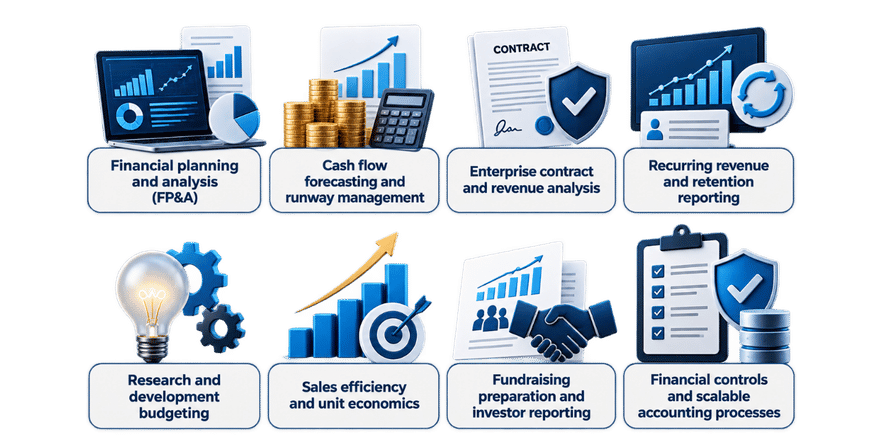
Core CFO responsibilities commonly include:
- Financial planning and analysis (FP&A)
- Cash flow forecasting and runway management
- Enterprise contract and revenue analysis
- Recurring revenue and retention reporting
- Research and development budgeting
- Sales efficiency and unit economics
- Fundraising preparation and investor reporting
- Financial controls and scalable accounting processes
The objective is to provide management with reliable financial visibility while supporting strategic investment decisions.
1. Managing Long Enterprise Sales Cycles
Many cybersecurity startups sell products and services to enterprise customers.
These transactions may involve technical evaluations, proof-of-concept projects, procurement reviews, security assessments, and contract negotiations.
As a result, the time between identifying a potential customer and collecting payment can be substantial.
A CFO should work with commercial leadership to build revenue forecasts that reflect realistic sales-cycle assumptions.
Forecasting should distinguish between qualified opportunities, expected contract execution, service commencement, billing, and actual cash collection.
A large sales pipeline does not automatically translate into near-term revenue or liquidity.
The CFO should also analyze sales-cycle duration, conversion rates, average contract values, and customer concentration.
These indicators help management evaluate the reliability of its commercial forecasts and identify potential cash flow risks.
2. Recurring Revenue, ARR, and Contract Economics
Cybersecurity startups frequently use subscription-based pricing models.
For these companies, Annual Recurring Revenue (ARR) and Monthly Recurring Revenue (MRR) can provide important insight into commercial performance.
However, recurring revenue metrics must be defined consistently.
Contracted value, annualized recurring revenue, recognized accounting revenue, and cash receipts are not interchangeable.
For example, a multiyear enterprise agreement may create a substantial contractual commitment while generating revenue and cash collections over different periods.
A CFO should establish clear reporting definitions and ensure that operational metrics can be reconciled with financial records.
Financial analysis should consider:
- New recurring revenue
- Contract renewals
- Expansion and upselling
- Downgrades and cancellations
- Customer concentration
- Contract duration
- Billing and collection terms
These measures help management evaluate the quality and predictability of its revenue base.
3. Research and Development Financial Planning
Cybersecurity companies often require substantial investment in engineering, threat research, product development, and security infrastructure.
These expenses may arise well before the company generates meaningful commercial revenue.
A CFO should develop budgets that connect research and development spending with product priorities and business milestones.
This may include evaluating engineering headcount, cloud infrastructure, testing environments, third-party technology, and specialized security tools.
Financial planning should distinguish between essential product development commitments and discretionary investments.
Management should also understand the cash implications of accelerating development timelines or expanding technical teams.
The accounting treatment of research and development expenses and certain software development costs requires analysis under applicable accounting standards.
For U.S. companies, relevant considerations may include ASC 730 and, depending on the nature of the software and its intended use, other applicable guidance.
The CFO should coordinate with qualified accounting and tax professionals when specialized technical judgments are required.
4. Cash Runway and Burn Rate Management
Cash management is particularly important for cybersecurity startups that invest in product development before achieving predictable enterprise revenue.
A CFO should establish rolling cash flow forecasts that incorporate expected customer collections, payroll, research and development costs, infrastructure expenditure, and commercial investments.
Forecasts should account for the timing of enterprise contracts and customer payments.
For example, delayed procurement approval or a postponed contract start date may reduce expected near-term cash receipts without immediately lowering operating expenses.
Scenario analysis should evaluate the effects of slower customer acquisition, longer sales cycles, increased engineering costs, and delayed fundraising.
The CFO should also monitor gross burn rate, net burn rate, and cash runway.
These indicators help founders determine whether available capital can support the company’s operating plan and strategic milestones.
5. Unit Economics and Customer Acquisition Efficiency
Cybersecurity startups must evaluate whether customer acquisition investments generate attractive long-term financial returns.
Enterprise sales frequently require specialized sales personnel, technical demonstrations, solution engineering, and extended customer engagement.
These activities can increase customer acquisition costs.
A CFO should analyze customer acquisition cost (CAC), customer lifetime value (LTV), gross margin, and CAC payback periods where the underlying data supports reliable calculations.
For subscription-based cybersecurity businesses, customer retention and expansion are also important.
Net Revenue Retention (NRR) can help management understand whether existing customers are increasing or reducing their recurring spending over time.
However, NRR should be evaluated alongside gross retention, customer concentration, and the cost of delivering services.
For companies providing managed security services or labor-intensive support, service delivery costs may have a significant effect on gross margin.
A strong CFO tailors unit economics to the company’s actual operating model rather than relying exclusively on generic SaaS benchmarks.
6. Financial Implications of Security and Compliance Requirements
Cybersecurity startups may face extensive customer requirements related to information security, data protection, contractual assurances, and independent assessments.
Enterprise customers may request security questionnaires, audit reports, certifications, or evidence of established controls.
Depending on the company’s business model and customers, relevant frameworks may include SOC 2, ISO/IEC 27001, or specific contractual and regulatory requirements.
These requirements can create financial commitments involving personnel, technology, external assessments, insurance, and ongoing operational processes.
A CFO should incorporate expected costs into budgets and financial forecasts.
The CFO may also help evaluate the financial implications of vendor agreements, contractual liabilities, and cyber insurance coverage.
However, the CFO does not replace the Chief Information Security Officer, security specialists, legal counsel, or compliance professionals.
The financial leadership role is to ensure that relevant investments and obligations are understood and reflected in business planning.
7. Fundraising and Investor Reporting for Cybersecurity Startups
Venture capital investors evaluating cybersecurity startups often examine growth potential, recurring revenue quality, customer retention, capital efficiency, and the company’s ability to scale.
A CFO should establish reporting processes that connect financial performance with relevant commercial and operating metrics.
A typical investor reporting package may include:
| Financial metric | Management purpose |
|---|---|
| ARR and MRR | Evaluate recurring revenue scale and growth |
| Revenue retention | Assess customer renewal and expansion performance |
| Gross margin | Understand product and service delivery economics |
| CAC and CAC payback | Evaluate acquisition efficiency |
| Cash runway | Estimate the period available capital can support operations |
| Net burn rate | Monitor cash consumption |
| Enterprise pipeline | Evaluate potential future commercial activity |
| Budget variances | Identify differences between planned and actual performance |
Pipeline metrics should be presented separately from contracted revenue and recognized accounting revenue.
The CFO should also prepare financial models and organize financial documentation for potential investor due diligence.
Clear definitions and consistent reporting methodologies help investors evaluate the company’s financial trajectory.
8. Building Financial Infrastructure for Scalable Growth
As cybersecurity startups expand, financial operations become increasingly complex.
Companies may manage multiple subscription products, enterprise contracts, international customers, service delivery teams, and different billing arrangements.
A CFO should evaluate whether accounting systems and financial reporting processes can support these activities.
Key priorities may include:
- Standardized monthly closing: Establish reliable accounting procedures and reporting timelines.
- Contract and billing integration: Connect customer agreements, invoicing, and revenue reporting.
- Revenue recognition processes: Apply appropriate accounting policies to subscriptions, licenses, and services.
- Expense allocation: Improve visibility into research, sales, infrastructure, and service delivery costs.
- Internal financial controls: Establish appropriate approval procedures and documentation.
- Management dashboards: Provide consistent reporting on cash, revenue, margins, and operational performance.
For U.S. companies, ASC 606 may be relevant to revenue recognition, particularly when customer agreements combine subscriptions, software licenses, implementation services, and other deliverables.
Technical accounting assessments should reflect the specific contract terms and applicable standards.
Fractional CFO vs. Full-Time CFO for Cybersecurity Startups
Not every cybersecurity startup requires a permanent, full-time CFO.
A fractional CFO can provide experienced financial leadership through a flexible engagement, which may be particularly appropriate for early-stage and growing companies.
| Consideration | Fractional CFO | Full-Time CFO |
|---|---|---|
| Engagement | Flexible, part-time | Permanent executive |
| Cost structure | Retainer or defined scope | Salary, benefits, and potentially equity |
| Financial forecasting | Provided within engagement scope | Continuous oversight |
| Investor reporting | Can be managed or supported | Ongoing executive responsibility |
| Enterprise contract analysis | Available when included in scope | Integrated into financial operations |
| Best suited for | Startups needing senior expertise without a full-time role | Companies with substantial ongoing financial complexity |
A fractional CFO may be suitable for cybersecurity startups preparing for fundraising, improving cash flow forecasting, or strengthening financial reporting.
A full-time CFO may become more appropriate when operational complexity, transaction volume, financing activity, or executive responsibilities require continuous involvement.
How to Choose the Right CFO for a Cybersecurity Startup
Founders should evaluate CFO candidates based on their ability to understand both venture-backed business dynamics and the commercial characteristics of cybersecurity companies.
Five questions can help guide the selection process:
- Do you have experience with venture-backed technology companies? Relevant experience supports understanding of fundraising, cash runway, and investor expectations.
- How would you forecast revenue from enterprise contracts? The candidate should understand sales cycles, contract execution, billing, and collections.
- Which financial metrics would you prioritize? Strong candidates should tailor reporting to the company’s revenue and service delivery model.
- How would you evaluate research and development spending? The CFO should connect technical investment decisions with financial planning.
- How would you prepare the company for future financing? The response should address financial models, reporting consistency, and due diligence readiness.
The most effective CFO should combine financial expertise with strong communication and the ability to collaborate with technical, commercial, and executive leadership.
How ERB Proximo Supports Cybersecurity Startups
ERB Proximo provides outsourced CFO and financial management services for startups and growing businesses operating in the United States.
For cybersecurity startups, effective financial leadership requires connecting financial planning, cash flow management, accounting, and business performance within a coordinated framework.
ERB Proximo’s services encompass CFO-level oversight, financial planning and analysis, accounting, controllership, and financial reporting.
An integrated approach can help founders strengthen financial visibility, improve forecasting processes, and establish reporting practices that support management decisions and investor communication.
These capabilities are particularly relevant as cybersecurity companies expand their commercial operations and prepare for future financing.
Frequently Asked Questions
1. What does a cybersecurity startup CFO do?
A cybersecurity startup CFO oversees financial planning, cash flow forecasting, capital allocation, financial reporting, and strategic financial decision-making. The role may also include enterprise revenue analysis, fundraising preparation, and investor reporting.
2. Why do cybersecurity startups need specialized financial management?
Cybersecurity startups may face long enterprise sales cycles, substantial research and development expenses, complex customer contracts, and recurring revenue models. Specialized financial leadership helps management understand how these factors affect cash flow and growth.
3. What financial metrics should a cybersecurity CFO track?
Relevant metrics may include ARR, MRR, revenue retention, gross margin, CAC, CAC payback, burn rate, cash runway, and budget variances. The appropriate metrics depend on the company’s business model.
4. Can a fractional CFO support a cybersecurity startup?
Yes. A fractional CFO can provide financial planning, forecasting, investor reporting, and strategic guidance through a flexible engagement. The scope should reflect the company’s commercial and financial complexity.
5. How can a CFO help with cybersecurity enterprise contracts?
A CFO can analyze contract economics, billing schedules, revenue recognition considerations, payment terms, and the financial implications of service commitments. Legal counsel remains responsible for legal review and contractual interpretation.
6. When should a cybersecurity startup hire a CFO?
A cybersecurity startup should consider CFO-level support when enterprise revenue becomes more complex, cash forecasting requires greater sophistication, fundraising approaches, or management needs stronger financial reporting and capital allocation processes.
Financial Leadership for Sustainable Cybersecurity Growth
Cybersecurity startups must balance technical innovation with disciplined financial management.
Enterprise sales cycles, research and development investments, recurring revenue economics, and investor expectations create financial challenges that require careful planning.
An experienced cybersecurity startup CFO helps founders understand these relationships, manage cash runway, evaluate investment decisions, and establish reliable financial reporting.
Whether delivered through a fractional or full-time engagement, effective CFO leadership can support stronger financial visibility and a more scalable foundation for growth.
Looking for CFO-level financial support for your cybersecurity startup?
Explore how ERB Proximo’s outsourced CFO and financial management services can support financial planning, reporting, and strategic decision-making as your cybersecurity company grows.