
For startups entering or expanding in the United States, the question of financial leadership often emerges earlier than expected.
The company may already have an accounting team in its home market. It may have a capable Controller, an experienced finance manager, or an external accounting firm. Yet as U.S. operations grow, founders begin facing a different category of financial questions.
How much should the company invest in U.S. expansion? How will a larger U.S. team affect runway? What financial information will American investors expect? How should management coordinate multiple entities? Is the company prepared for another financing round? How should U.S. performance be incorporated into the global forecast?
These are not primarily bookkeeping or accounting questions.
They are financial management and capital allocation questions.
For some startups, hiring a U.S.-based CFO can provide significant value. A CFO who understands the U.S. business environment can help connect financial planning with local operations, investors, fundraising, reporting expectations, and the broader financial infrastructure required to scale in the market.
But that does not mean every startup needs a full-time U.S. CFO.
The more important question is whether the company needs U.S.-focused CFO capabilities — and, if it does, whether those capabilities should come from a permanent executive or an outsourced CFO model.
The Decision Should Be Based on Complexity, Not Geography Alone
Establishing a U.S. entity does not automatically create the need for a U.S.-based CFO.
A startup with a small American sales presence, limited transaction volume, and a strong existing finance organization may be able to manage its U.S. financial requirements through accounting, tax, payroll, and other professional service providers.
The situation changes as the U.S. operation becomes financially significant.
Suppose a startup raises institutional capital and plans to invest several million dollars in U.S. growth. It begins hiring Sales, Marketing, and Customer Success employees. Enterprise customers increase reporting and contracting complexity. Management prepares for another financing round. The board wants more sophisticated forecasting. U.S. revenue becomes an important part of the company’s valuation story.
At this point, the company does not simply have a U.S. subsidiary.
It has a U.S. financial strategy.
Someone needs to connect the commercial plan with headcount, budget, cash, runway, KPIs, investor expectations, and group financial reporting.
That is CFO-level work.
The decision framework therefore looks less like:
U.S. Entity → Hire U.S. CFO
and more like:
U.S. Complexity → Strategic Finance Requirements → Required CFO Capabilities → Full-Time or Outsourced Model
This distinction can prevent startups from hiring too early while also avoiding the opposite problem: waiting until founders are already overwhelmed by financial complexity.

A U.S.-Based CFO Connects Market Strategy With Financial Strategy
Entering the U.S. is typically an investment before it becomes a return.
Employees need to be hired. Sales capacity needs to be established. Marketing programs may need funding. Legal, accounting, payroll, insurance, software, and other infrastructure create additional expenses.
Revenue may take longer to develop.
For this reason, U.S. expansion should be treated as a capital allocation decision.
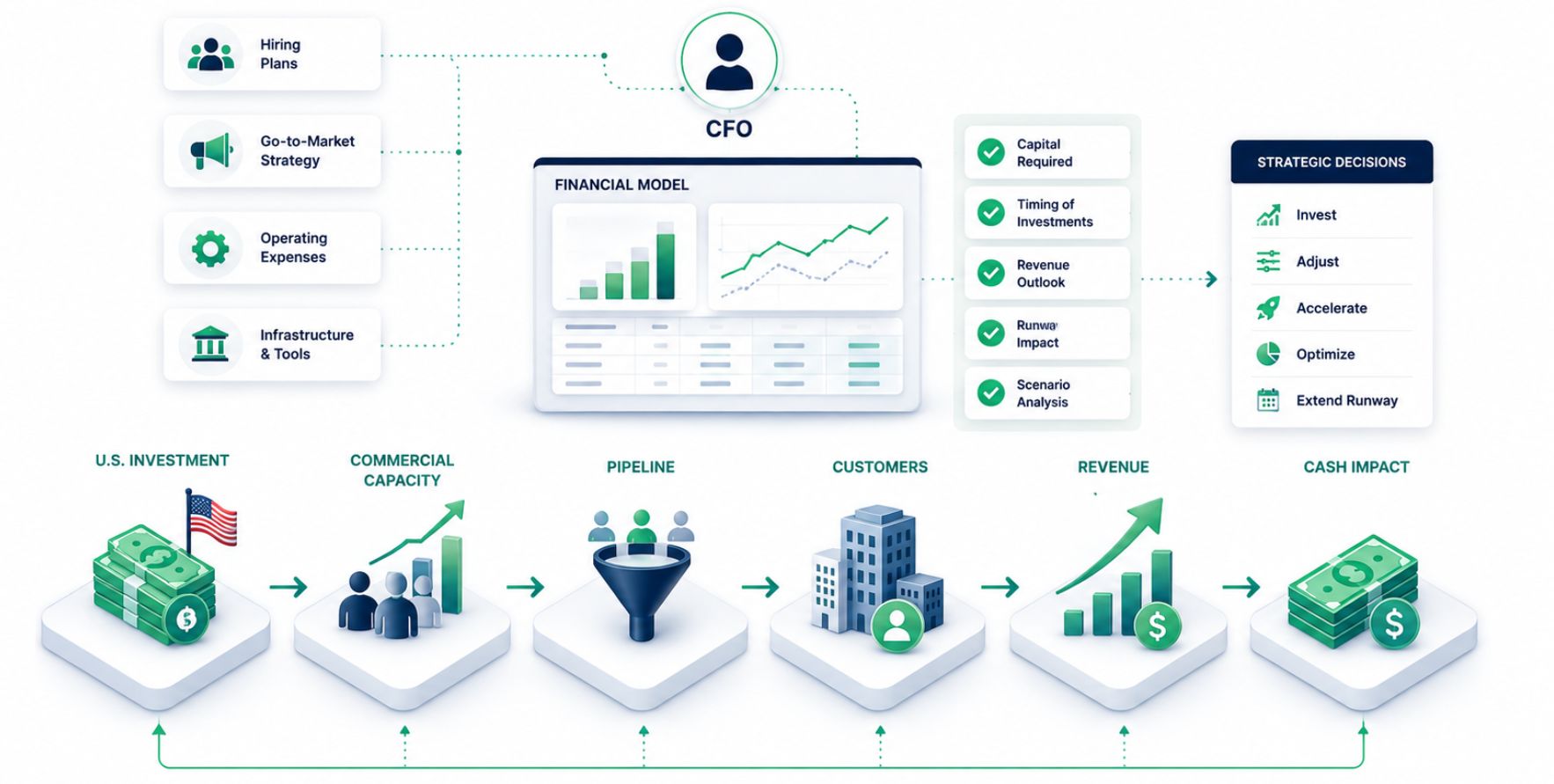
A CFO can translate the commercial strategy into a financial model showing how much capital the expansion requires, when spending occurs, when revenue is expected to develop, and how different outcomes affect consolidated runway.
Consider a company planning to build a U.S. enterprise sales organization.
The operating plan may call for a VP of Sales, several account executives, Sales Development Representatives, Marketing support, and Customer Success capacity.
Finance should model much more than salaries.
Each hiring decision can affect benefits, commissions, recruiting, software, travel, marketing, support capacity, and other costs. Those investments should then be connected with assumptions around pipeline, sales cycles, bookings, revenue, and collections.
The model becomes:
U.S. Investment → Commercial Capacity → Pipeline → Customers → Revenue → Cash Impact
This gives founders a framework for determining whether the U.S. strategy is progressing according to plan.
U.S. Investor Expectations Can Change the Finance Function
For venture-backed startups, one of the strongest arguments for U.S.-focused CFO leadership is investor communication.
Institutional investors typically expect management to understand the company’s financial position at a level that goes beyond historical financial statements.
Depending on the stage and business model, board and investor discussions may involve revenue growth, ARR, gross margin, burn, runway, headcount, budget performance, forecast changes, unit economics, customer retention, capital requirements, and other operational KPIs.
The CFO helps create consistency between those metrics and the underlying financial model.
This matters because investors are rarely interested in numbers in isolation.
If burn increased, they want to understand why.
If revenue missed plan, they want to understand whether the issue was pipeline generation, conversion, sales cycles, customer timing, churn, or another factor.
If management wants to accelerate hiring, investors may want to understand the expected return on that investment and its impact on runway.
The CFO helps founders move from reporting results to explaining the financial logic behind them.
For international founders building relationships with U.S. investors, having CFO leadership familiar with these conversations can also make financial communication more efficient.
Fundraising Can Be a Major Trigger
A startup preparing to raise capital in the United States may reach the point where CFO-level support becomes particularly valuable.
Fundraising requires more than creating financial projections.
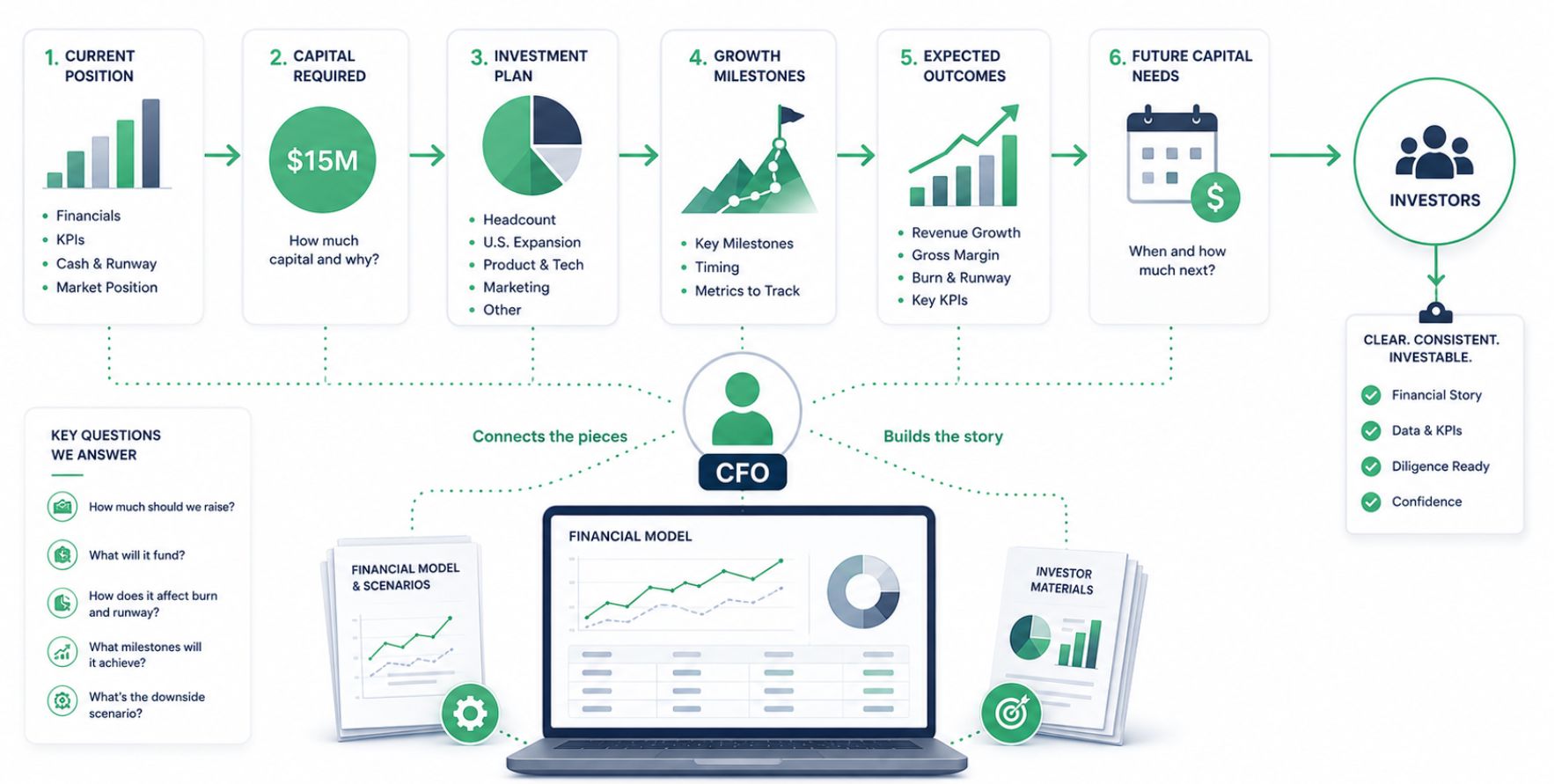
Management needs to determine how much capital to raise, what that capital should accomplish, how long it should last, and which assumptions support the company’s financial plan.
Investors may also examine historical financial information, KPIs, customer economics, forecasts, capitalization, cash requirements, and other financial materials during diligence.
A CFO helps connect these elements into a coherent financial story.
The logic should be visible:
Current Position → Capital Required → Investment Plan → Growth Milestones → Expected Financial Outcomes → Future Capital Needs
If management asks for $15 million, for example, Finance should be able to explain why that amount is appropriate.
How much will go toward headcount?
How much toward U.S. commercial expansion?
What happens to burn?
Which milestones should the capital finance?
What runway remains under a downside scenario?
What does the company expect to look like before another financing becomes necessary?
A strong CFO does not simply produce the spreadsheet behind the fundraising round.
The CFO helps management determine whether the financial strategy itself makes sense.
U.S. Operations May Need to Connect With a Global Finance Organization
For international startups, hiring a U.S.-based CFO does not mean creating a separate American finance organization disconnected from the rest of the company.
In fact, the opposite is usually more useful.
The CFO should connect U.S. financial activity with the company’s global operations.
A startup may have its parent company in one jurisdiction, a U.S. subsidiary generating revenue, and an international development subsidiary employing a significant portion of its Engineering team.
Management still needs one consolidated financial view.
That requires coordination around accounting, reporting, cash, intercompany balances, budgets, forecasts, and financial policies.
The financial architecture may look like:
Local Accounting → Standardized Reporting → Consolidation → FP&A → Management Decisions
The U.S. CFO can operate at the group level while working with local accountants, Controllers, payroll providers, tax professionals, and other specialists.
This becomes particularly important when U.S. growth affects international operations.
If the U.S. sales organization grows rapidly, the company may need additional Engineering, implementation, or Customer Success resources elsewhere.
The CFO needs to capture the entire economic effect rather than analyzing the U.S. entity in isolation.
A CFO Can Create Better Visibility Into U.S. Performance
Once meaningful capital is being invested in the U.S., founders need a way to evaluate the return on that investment.
Revenue alone may not provide enough information.
Suppose U.S. revenue is growing quickly, but Sales and Marketing spending is growing even faster. Is that expected during the market-entry stage, or is customer acquisition becoming inefficient?
Alternatively, U.S. revenue may initially be below plan while pipeline, enterprise opportunities, and customer engagement are significantly ahead of expectations. Management may reasonably conclude that the strategy is working but needs additional time.
A CFO can establish reporting that connects financial investment with operational results.
Depending on the company’s business model, management might evaluate U.S. headcount, payroll, operating expenses, pipeline, bookings, revenue, gross margin, CAC, retention, collections, and cash burn.
The useful relationship is:
Capital Invested → Capacity Built → Commercial Activity → Revenue → Unit Economics → Cash
This provides a much stronger framework for deciding whether management should accelerate, maintain, modify, or reduce its U.S. investment.
A U.S. CFO Does Not Replace Tax, Legal or Accounting Specialists
The CFO role should not be confused with every specialized financial requirement a company encounters in the United States.
U.S. corporate structure, federal and state tax requirements, payroll, employment matters, transfer pricing, legal compliance, and other specialized areas may require qualified professionals.
A CFO coordinates these areas from a financial-management perspective but does not necessarily replace the specialists responsible for them.
This distinction becomes particularly important for international startups.
The CFO may work with a U.S. tax advisor on tax compliance, attorneys on corporate or financing matters, payroll providers on employee compensation, accountants on transaction processing, and local advisors in other jurisdictions.
The CFO’s contribution is to connect these activities with the broader financial organization.
For example, expected tax payments should appear in the cash forecast. Payroll should connect with the headcount model. Entity-level accounting should feed consolidated reporting. Corporate decisions should be reflected in budgets and forecasts.
The operating model becomes:
Specialized Expertise + CFO Coordination → Integrated Financial Management
This allows founders to benefit from specialists without personally becoming the central coordinator of every financial relationship.
Full-Time CFO or Outsourced CFO?
Once management determines that it needs CFO-level capabilities, the next question is whether the position needs to be full-time.
For some startups, the answer is clearly yes.
A larger company with substantial revenue, complex operations, frequent financing or M&A activity, a significant internal finance organization, and extensive board responsibilities may benefit from a permanent executive CFO.
But many startups reach the need for sophisticated financial leadership before they need 40 or 50 hours of CFO capacity every week.
This creates a strong use case for an outsourced CFO.
An outsourced model can give founders access to senior financial leadership while allowing the scope to reflect the company’s current stage.
The outsourced CFO may lead forecasting, budgeting, board reporting, cash and runway management, fundraising support, U.S. expansion planning, financial controls, and coordination across the broader finance function.
Meanwhile, accounting, bookkeeping, controllership, payroll, and tax functions can be handled by the appropriate internal or external teams.
The structure can evolve naturally:
Accounting → Controllership → FP&A → Outsourced CFO → Full-Time CFO
Importantly, this is not necessarily a rigid sequence.
Companies may require several of these capabilities simultaneously, and some may remain outsourced even after others move in-house.
The objective is to build the right finance organization for the company’s current complexity.
The Cost Question Should Consider What the Company Actually Needs
Comparing an outsourced CFO with a full-time CFO purely on annual compensation can miss the more important issue.
The company should first determine what work needs to be done.
Does management need a senior executive to run a large internal Finance organization every day?
Or does it primarily need experienced leadership around forecasting, fundraising, board reporting, cash management, U.S. expansion, and strategic decisions?
If the second description is more accurate, hiring a full-time executive may create more capacity than the company currently requires.
Conversely, a rapidly scaling startup should not use outsourcing simply to postpone a necessary executive hire.
The appropriate model changes over time.
Founders should evaluate the level of financial complexity, frequency of strategic decisions, size of the finance team, investor requirements, transaction volume, and the amount of CFO involvement required by management.
The question is not:
“Which CFO model is cheaper?”
It is:
“Which financial leadership model gives the company the capabilities it needs at this stage?”
When Does a Full-Time U.S. CFO Make More Sense?
There is no universal revenue or funding threshold at which every startup should hire a full-time CFO.
The decision depends on organizational complexity.
However, several developments can indicate that the role is becoming sufficiently demanding for permanent executive leadership.
The company may have a substantial internal Finance organization requiring daily management. The CFO may be deeply involved in board activity, capital markets, acquisitions, investor relations, strategic transactions, or complex global operations. Management may need the CFO involved continuously across major business decisions.
At that stage, a permanent CFO can become an integral member of the executive team.
The transition should ideally occur because the scope of the role has expanded, not simply because the company reached an arbitrary size.
An outsourced CFO can also help prepare for this transition by establishing the reporting, forecasting, processes, controls, and financial team structure that the eventual internal CFO will inherit.
That can make the first full-time CFO hire more effective.
What Should Founders Look for in a U.S. CFO?
The right profile depends on the company’s stage.
For a venture-backed startup, technical accounting knowledge alone may not be enough. The CFO should be able to connect financial information with operating decisions.
Founders may want to evaluate experience with startup forecasting, SaaS or relevant industry metrics, cash and runway management, institutional investors, board reporting, fundraising, U.S. expansion, multi-entity operations, financial controls, and building finance organizations.
Communication is equally important.
A strong startup CFO needs to explain complex financial information clearly to founders who may not have finance backgrounds. The CFO should be able to challenge assumptions constructively while remaining commercially oriented.
Founders should also consider whether the CFO understands the company’s stage.
Processes appropriate for a $500 million organization may create unnecessary friction inside a startup. At the same time, processes designed for a ten-person company may no longer provide sufficient control for a venture-backed organization deploying millions of dollars.
The CFO needs to understand the difference.
How ERB Proximo Provides U.S.-Based CFO Support
For startups expanding into the United States, CFO requirements frequently develop alongside other financial needs.
The company may simultaneously require U.S. accounting, controllership, bookkeeping, payroll, tax compliance, financial modeling, forecasting, multi-entity reporting, and strategic financial leadership.
ERB Proximo supports startups and growth companies through an integrated financial model that includes outsourced CFO services, accounting, bookkeeping, controllership, payroll, FP&A, financial modeling, forecasting, U.S. tax compliance, entity setup, and financial operations for multinational companies.
For international startups, this structure can provide U.S.-focused financial leadership while connecting American operations with the company’s broader global finance function.
Instead of treating the U.S. subsidiary as an isolated financial operation, CFO leadership can incorporate its budget, hiring, revenue, cash requirements, and performance into consolidated management reporting and group-level planning.
With a U.S. presence in California and New York, ERB Proximo works with companies operating within major American business and technology markets.
This model can be particularly relevant for companies that need sophisticated U.S. financial leadership but have not yet reached the point where a permanent CFO is the appropriate next hire.
Frequently Asked Questions
Does every startup expanding to the U.S. need a U.S.-based CFO?
No. The need depends on financial complexity, funding stage, U.S. investment, reporting requirements, and the capabilities of the existing finance organization.
When should a startup consider U.S.-based CFO support?
CFO support may become valuable when U.S. operations materially affect burn and runway, institutional investors become involved, fundraising is approaching, management requires sophisticated forecasting, or multiple entities make financial coordination more complex.
Can an outsourced CFO work with an existing international finance team?
Yes. An outsourced CFO can provide U.S. and group-level financial leadership while working with an existing Controller, accounting team, bookkeepers, tax professionals, payroll providers, and other specialists.
Does a U.S. CFO handle U.S. taxes?
A CFO can coordinate tax planning and compliance within the broader financial function, but specialized tax matters should be handled by appropriately qualified U.S. tax professionals.
Can an outsourced CFO support U.S. fundraising?
Yes. CFO support can include financial modeling, fundraising scenarios, investor metrics, due diligence preparation, cash and runway planning, and the financial components of investor reporting.
When should an outsourced CFO become a full-time CFO?
The transition often makes sense when the volume and complexity of CFO responsibilities require continuous executive involvement and the company has sufficient scale to justify a permanent senior finance leader.
Hire the Capability Before You Hire the Title
The most useful way for founders to approach this decision is not to begin with the job title.
Begin with the financial problems the company needs to solve.
If management needs better forecasting, build forecasting.
If investors require more sophisticated reporting, build reporting.
If U.S. expansion is changing the company’s burn profile, build a financial model that reflects it.
If multiple entities are creating fragmented visibility, establish consolidated financial management.
If founders are preparing for fundraising, make sure Finance can support the process before diligence begins.
At some point, the number and importance of those responsibilities may clearly justify a full-time U.S.-based CFO.
Before that point, an outsourced CFO can provide many of the same strategic capabilities without requiring the company to build the final version of its finance organization too early.
For startups, that distinction matters.
The goal is not to hire a CFO because the company has entered the United States.
The goal is to make sure the company has the financial leadership required to succeed there.