
Entering the U.S. market is often treated as a commercial milestone. Founders focus on customers, sales, partnerships, hiring, and establishing a local presence.
But behind every successful U.S. expansion sits another layer of work: financial infrastructure.
A company may have a strong product, growing international revenue, and sufficient capital to enter the United States, yet still encounter operational problems if its finance function was designed for a smaller, single-market organization. U.S. expansion can introduce a new legal entity, additional bank accounts, payroll, employees across multiple states, new accounting and tax requirements, intercompany transactions, local vendors, different currencies, more sophisticated investor reporting, and significantly greater cash requirements.
The challenge is that these elements are connected.
Entity structure affects accounting. Accounting affects reporting. Hiring affects payroll and cash. Intercompany activity affects consolidation. Tax obligations affect cash forecasts. The U.S. operating plan affects runway and potentially the timing of the next fundraising round.
Founders therefore should not ask only:
“What do we need in order to start operating in the U.S.?”
A more useful question is:
“What financial infrastructure do we need so that the U.S. operation can scale without reducing our visibility or control?”
The answer will differ by company. But for many startups, the foundation includes entity and banking infrastructure, reliable accounting, payroll and expense processes, financial controls, multi-entity reporting, forecasting, tax coordination, KPI reporting, and CFO-level financial planning.
The objective is not to build the finance organization of a large corporation before entering the market.
It is to build enough infrastructure that Finance can grow with the U.S. business rather than constantly trying to catch up with it.
Start With the Financial Architecture, Not the Accounting Software
Founders often begin financial infrastructure discussions by asking which accounting platform, payroll provider, or expense-management system they should use.
Those are important decisions, but they should come later.
The first question is how the U.S. business will actually operate.
Will the company establish a U.S. entity? Which activities will occur through that entity? Will it employ U.S. personnel? Which entity will contract with customers? Where will revenue be collected? Which company will pay U.S. expenses? How will the U.S. operation be funded? Will services or expenses move between the U.S. company and international entities?
Legal and tax specialists should advise on the appropriate corporate and tax structure. The CFO’s role is different: Finance needs to translate that structure into an operating model.
Once management understands how the business will function, it can determine which systems and processes are required.
For example, a startup establishing a small U.S. sales operation may initially need a relatively simple financial setup. Another company planning significant U.S. revenue, dozens of employees, and several operating locations may require substantially more infrastructure from the beginning.
The sequence should therefore be:
Business Model → Entity Structure → Financial Workflows → Systems → Reporting
Starting with software can produce the opposite result: tools are implemented before management has defined what information needs to move through them.
Build Reliable U.S. Accounting From Day One
A startup entering the U.S. does not necessarily need an elaborate accounting organization. It does need reliable books.
The accounting foundation should allow Finance to understand revenue, expenses, assets, liabilities, cash, payroll-related activity, receivables, payables, and other material transactions associated with the U.S. operation.
The structure should also anticipate management reporting.
If founders expect to analyze U.S. Sales separately from global Sales, the accounting and reporting framework should support that distinction. If management needs departmental budgets, financial data should be captured in a way that allows expenses to be compared with those budgets.
The chart of accounts should therefore be designed not simply for transaction recording but also for future analysis.
Another important consideration is the monthly close.
Management should know when the U.S. books will close, who owns each process, how accounts are reconciled, when management reports become available, and how U.S. financial information will be incorporated into consolidated reporting.
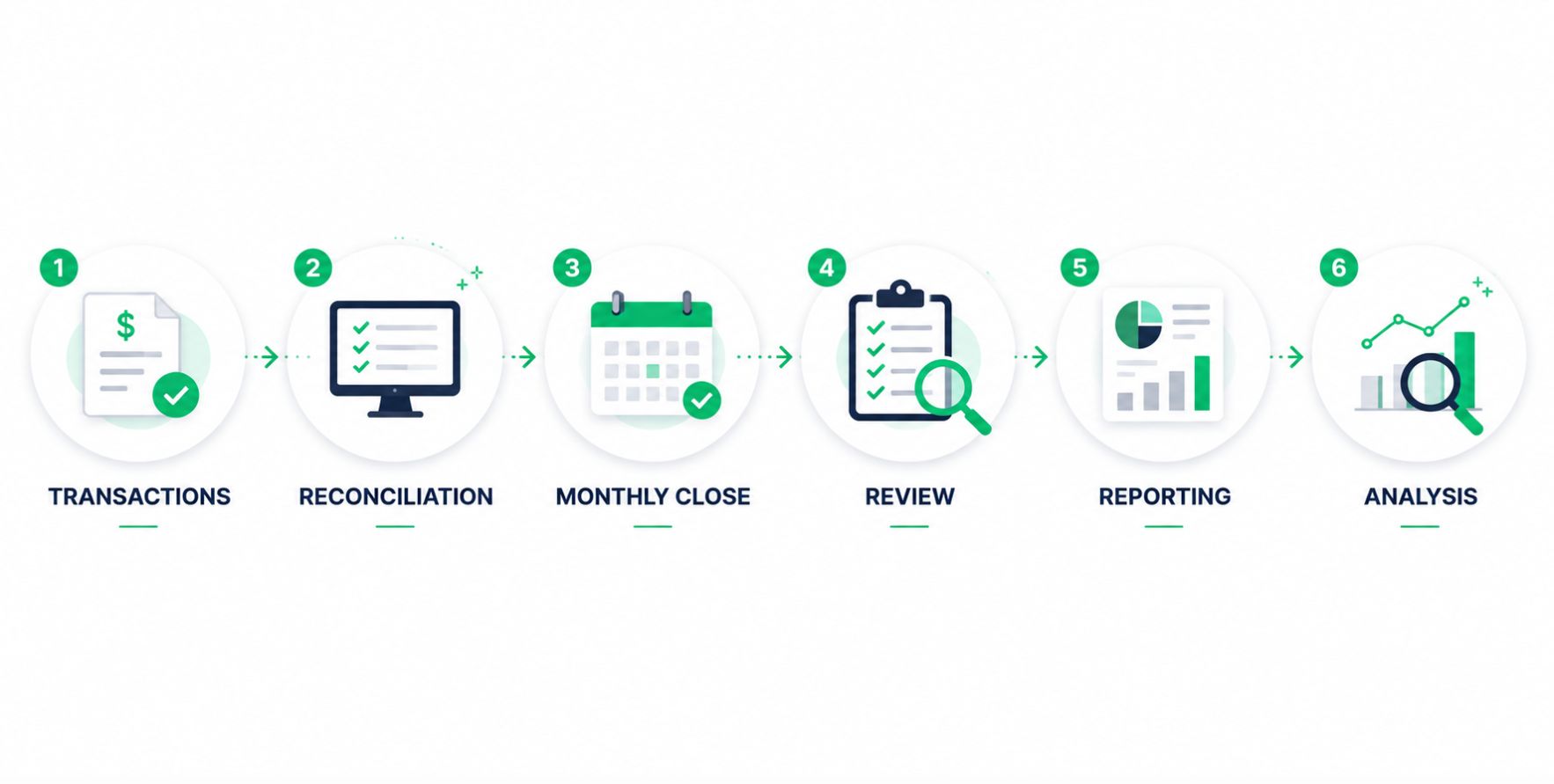
A useful operating rhythm is:
Transactions → Reconciliation → Monthly Close → Review → Reporting → Analysis
Without a disciplined close, financial information can become progressively less useful as the business accelerates.
Reliable accounting creates the foundation on which every more sophisticated financial capability depends.
Establish Banking, Payments and Cash Visibility
Opening a U.S. bank account solves only one part of cash management.
As the operation develops, the company may collect customer payments, pay employees and vendors, use corporate cards, reimburse expenses, transfer funds between entities, and maintain cash across several accounts or currencies.
Management needs visibility across those activities.
Before scale increases transaction volume, Finance should establish clear rules around who can access accounts, who can initiate and approve payments, how vendor information is verified, how corporate cards are issued, how expenses are documented, and how cash balances are incorporated into group reporting.
These processes form part of the company’s financial controls.
Cash reporting should also be designed at both the entity and consolidated levels.
Founders need to understand:
Where is cash held?
Which entity is consuming it?
What major payments are coming?
When will the U.S. operation require additional funding?
How does U.S. spending affect consolidated runway?
This becomes especially important for international companies where financing proceeds may sit with one entity while operating costs occur in another.
The CFO should ultimately be able to move from individual bank balances to a forward-looking picture of group liquidity.
Payroll Infrastructure Should Be Ready Before Hiring Accelerates
Hiring employees without scalable payroll and financial processes can quickly create unnecessary complexity.
Before building the U.S. team, management should determine how employees will be onboarded financially, how payroll will operate, how compensation and benefits information flows into accounting, and how headcount connects to budgeting and forecasting.
U.S. payroll requirements can vary depending on employee location and other circumstances. Appropriate payroll, employment, tax, and legal specialists should therefore be involved when determining specific obligations.
From the CFO perspective, however, payroll is also part of financial planning.
Each approved position should connect to the company’s headcount plan and forecast.
The financial impact may extend beyond salary to employer costs, benefits, bonuses or commissions, recruiting, equipment, software, travel, and other expenses.
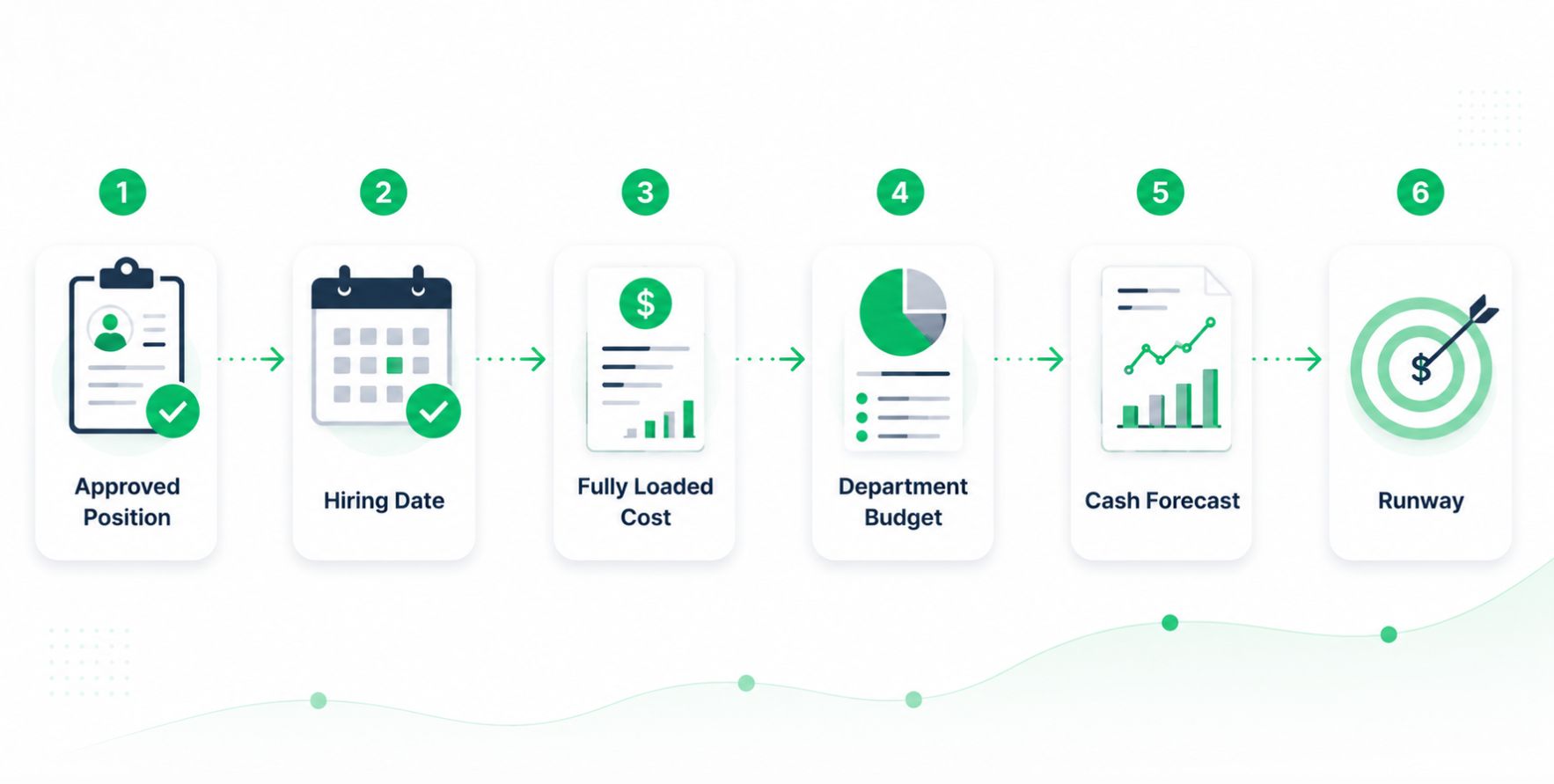
This creates a more complete planning relationship:
Approved Position → Hiring Date → Fully Loaded Cost → Department Budget → Cash Forecast → Runway
For many startups, payroll eventually becomes the largest recurring cash expense. It should therefore never operate independently from FP&A.
If Sales accelerates hiring, Finance should immediately understand the effect on burn. If Engineering hiring is delayed, the forecast should reflect both lower spending and the possible operational consequences.
Financial Controls Should Scale With the Amount of Capital at Risk
Startups sometimes associate financial controls with large public companies.
In reality, even a relatively small U.S. operation benefits from basic controls.
As more employees gain authority to purchase software, hire vendors, approve expenses, issue cards, or enter contracts, founders can no longer personally review every financial decision.
The company therefore needs clear rules.
Who can approve a $5,000 expense?
What about $50,000?
Who can add a new vendor?
Can the same person create and approve a payment?
Who reviews payroll changes?
How are corporate cards controlled?
Who can sign contracts that create recurring financial commitments?
The appropriate framework should reflect the company’s size and risk profile. Early-stage companies do not need unnecessary bureaucracy.
But they do need accountability.
A simple structure can be:
Request → Approval → Payment → Recording → Reconciliation → Review
This reduces the risk of errors, duplicate payments, unauthorized spending, fraud, and financial surprises.
Controls also improve data quality. When expenses are approved and categorized consistently, budgeting and forecasting become more reliable.
Multi-Entity Infrastructure Should Exist Before Intercompany Activity Becomes Complicated
For international founders, entering the U.S. frequently creates a multi-entity organization.
That means Finance needs to preserve the accounting integrity of each legal entity while also giving management a consolidated view.
Intercompany transactions deserve particular attention.
The parent may fund the U.S. subsidiary. One entity may pay expenses on behalf of another. Employees in one jurisdiction may support operations elsewhere. Shared technology or professional services may be allocated between companies.
These arrangements can have accounting, tax, legal, and transfer-pricing implications and should be structured with qualified advisors.
Financially, the important point is that intercompany transactions should be identifiable and regularly reconciled.
A disciplined process looks like:
Record → Match → Reconcile → Adjust → Eliminate → Consolidate
Waiting until the first audit, fundraising process, or due diligence request to reconcile historical intercompany balances can create significant unnecessary work.
The CFO should establish the process while transaction volumes are still manageable.
Build Consolidated Reporting Before Management Needs It Urgently
A U.S. subsidiary can produce perfectly accurate financial statements while management still lacks a useful picture of the company.
Founders generally need both entity-level reporting and group-level reporting.
At the entity level, management may want to understand U.S. revenue, payroll, operating expenses, receivables, cash, and performance against the U.S. budget.
At the consolidated level, management needs total company revenue, gross margin, operating expenses, burn, cash, runway, and relevant KPIs.
The CFO should design a reporting architecture that allows management to move between these perspectives.
For example:
| Management Question | Financial View |
|---|---|
| What does the U.S. operation cost? | U.S. entity / geography |
| How much are we spending on Sales globally? | Department |
| Which entity requires cash? | Entity-level cash |
| What is total company burn? | Consolidated |
| Is U.S. expansion performing against plan? | Budget vs. actual |
| How much runway remains? | Consolidated forecast |
This is where standardized financial data becomes important.
Different entities may use different local systems, but their information should ultimately map into a common management-reporting structure.
Build the U.S. Budget Before Committing the Capital
U.S. expansion should have its own financial model before significant spending begins.
The model should translate management’s commercial strategy into hiring, expenses, revenue assumptions, cash requirements, and milestones.
A useful expansion forecast might include U.S. headcount by function and expected start date, compensation and related costs, sales and marketing investment, professional services, technology, insurance, travel, operational costs, expected customer acquisition, revenue timing, collections, and other relevant assumptions.
But a single forecast is not enough.
Entering a new market contains uncertainty, particularly around revenue timing.
Management should therefore understand what happens if commercial traction develops more slowly than expected.
For example:
| Scenario | U.S. Performance | Financial Response |
|---|---|---|
| Downside | Revenue delayed | Protect runway / phase hiring |
| Base Case | Performance on plan | Execute operating plan |
| Upside | Faster traction | Evaluate acceleration |
This does not mean management should automatically reduce investment when performance changes.
It means management should understand its options.
A well-designed model allows founders to see the financial consequences of those options before making the decision.
Cash Forecasting Should Connect U.S. Expansion With Group Runway
One of the most important pieces of infrastructure is a forward-looking cash model.
Historical burn can become misleading once U.S. expansion begins.
If the company spent $400,000 per month during the previous six months but plans significant U.S. hiring, historical burn does not describe the company’s future cash requirements.
The forecast needs to reflect the organization the startup is building, not simply the one it currently operates.
Finance should connect:
Current Cash → U.S. Investment → Hiring → Operating Expenses → Expected Revenue → Cash Collections → Consolidated Burn → Remaining Runway
Scenario analysis is particularly useful here.
What happens if U.S. revenue arrives three months late?
Six months late?
What happens if hiring is completed faster than expected?
What happens if the company decides to accelerate after strong early traction?
How does each scenario change the timing of the next financing requirement?
For venture-backed startups, runway should also be connected to milestones.
The question is not simply whether the company has 18 months of cash.
The more strategic question is:
What should the company accomplish with those 18 months before it needs additional capital?
Tax and Compliance Should Be Built Into the Finance Calendar
U.S. financial infrastructure should incorporate tax and compliance from the beginning rather than treating them as year-end activities.
The specific obligations depend on the company’s structure, locations, employees, customers, and activities. Federal, state, and potentially local considerations may apply, and qualified tax and legal professionals should determine the company’s specific requirements.
The CFO’s role is to coordinate those requirements with financial operations.
Important deadlines can be incorporated into a centralized compliance calendar. Required information can be identified in advance. Expected payments can be incorporated into cash forecasts.
The relationship becomes:
Business Activity → Compliance Requirement → Financial Data → Filing/Payment → Cash Impact
This becomes increasingly valuable as the company expands into additional states or adds employees in new locations.
Finance should ideally learn about these changes before they occur, not several months afterward.
KPI Infrastructure Should Be Designed Before Investor Reporting Becomes More Sophisticated
U.S. expansion often coincides with a more advanced stage of company growth.
Investors and boards may begin expecting greater visibility into financial and operating KPIs.
For SaaS companies, this could include ARR, MRR, NRR, GRR, churn, gross margin, CAC, CAC payback, burn multiple, and runway. Other business models will require different metrics.
The important infrastructure is not the dashboard itself.
It is the data and definitions underneath it.
If management reports ARR, everyone should understand what is included in ARR.
If CAC is reported, the methodology should remain consistent.
If U.S. revenue is compared with international revenue, geographic definitions should be clear.
This creates:
Source Data → Consistent Definitions → KPI Calculation → Management Reporting → Investor Reporting
Establishing those definitions early prevents a common problem: rebuilding historical metrics when investors request them during fundraising.
Founders Need an Integrated Monthly Financial Rhythm
The strongest finance infrastructure is not simply a collection of systems.
It is a recurring process.
Once the accounting period closes, Finance should compare actual performance with budget, investigate material variances, update hiring assumptions, review cash, reassess revenue expectations, and update the forecast.
Management can then make decisions using current information.
A mature monthly cycle might look like:
Close → Consolidate → Analyze → Reforecast → Review Cash → Management Discussion → Decide
For the U.S. operation, this allows founders to see early whether the expansion is developing according to plan.
Perhaps Sales hiring is ahead of schedule but pipeline is behind.
Perhaps revenue is ahead of plan but collections are slower.
Perhaps hiring is delayed, extending runway but also limiting growth capacity.
The value of financial infrastructure is that these signals appear while management can still respond to them.
Not Every Startup Needs a Full-Time CFO Before U.S. Expansion
Building CFO-level financial infrastructure does not automatically require hiring a full-time CFO.
For many international startups, the financial complexity of entering the United States appears before the organization is large enough to justify another permanent C-suite executive.
An outsourced CFO model can provide strategic financial leadership while working alongside accountants, Controllers, payroll providers, tax advisors, attorneys, and the company’s internal team.
The finance organization can evolve gradually:
Bookkeeping & Accounting → Controllership → FP&A → CFO Leadership → Internal Finance Team
Some of these capabilities may be outsourced initially and brought in-house as the company scales.
The important issue is not who employs each member of the finance function.
It is whether the necessary capabilities exist when management needs them.
How ERB Proximo Helps Build Financial Infrastructure for U.S. Expansion
For an international startup entering the United States, financial infrastructure can span several interconnected functions.
ERB Proximo supports startups and growth companies through services including U.S. entity setup, outsourced CFO services, accounting, bookkeeping, controllership, payroll, tax compliance, FP&A, forecasting, financial modeling, and financial operations for multinational companies.
An integrated approach can be particularly valuable during U.S. expansion because these functions should not develop independently.
The entity structure needs to connect with accounting. Accounting needs to support management reporting. Payroll needs to connect with headcount forecasting. The U.S. budget needs to connect with consolidated cash and runway. Intercompany activity needs to connect with group reporting. And all of this needs to provide founders with information they can use to make decisions.
With a U.S. presence in California and New York, ERB Proximo supports companies establishing and scaling operations across important American business and technology markets.
The objective is not to make a startup’s finance function unnecessarily complex.
It is to build a financial foundation capable of supporting the complexity that successful U.S. growth may eventually create.
Frequently Asked Questions
What financial systems does a startup need before entering the U.S.?
Requirements vary, but startups may need accounting, banking, payroll, expense management, accounts payable and receivable processes, management reporting, forecasting, and appropriate tax and compliance workflows.
Should financial infrastructure be built before forming a U.S. entity?
The financial architecture should ideally be considered during the planning stage. Corporate structure decisions should involve qualified legal and tax advisors, while Finance can determine how the resulting structure will operate from an accounting, reporting, cash, and planning perspective.
Does a U.S. subsidiary need separate accounting?
A separate legal entity generally needs appropriate financial records. The specific accounting and reporting requirements depend on the company’s structure and should be determined with qualified professionals. Management may additionally require consolidated reporting across the group.
When should a startup begin forecasting U.S. expansion costs?
Ideally before major financial commitments are made. The forecast can help management evaluate hiring, operating costs, expected revenue, cash requirements, downside scenarios, and the effect on consolidated runway.
Can an outsourced CFO build U.S. financial infrastructure?
Yes. An outsourced CFO can help design reporting, budgeting, forecasting, cash planning, controls, multi-entity processes, and management reporting while coordinating with accounting, tax, payroll, and legal specialists.
How much financial infrastructure does an early-stage startup need?
The appropriate level depends on company size, transaction volume, funding, headcount, corporate structure, and expansion plans. The objective should be sufficient control and visibility without creating unnecessary administrative complexity.
Build for the Company You Are About to Become
The strongest argument for building financial infrastructure before entering the United States is not compliance.
It is optionality.
When management has reliable accounting, a realistic forecast, clear cash visibility, scalable controls, and consistent reporting, founders can respond faster as they learn about the U.S. market.
If demand exceeds expectations, they can evaluate acceleration.
If sales cycles are longer than planned, they can understand how much time remains.
If hiring moves faster than revenue, they can see the effect on runway.
If investors begin asking more sophisticated questions, the financial information already exists.
If another financing round becomes necessary, Finance does not need to reconstruct the company’s financial history under pressure.
Good financial infrastructure does not predict exactly what will happen in the United States.
It gives management the ability to respond intelligently when reality differs from the original plan.
That is why the best time to build it is before growth makes it urgent.