
For many venture-backed startups, forming a Delaware C-Corporation is an important step in building a company designed to raise institutional capital, issue equity, hire employees, and scale in the United States. But incorporation is only the beginning.
Once the entity exists, founders need to build the financial infrastructure that allows the corporation to operate effectively.
That means establishing accounting processes, managing cash, building budgets and forecasts, tracking equity-related activity, coordinating tax and compliance requirements, supporting board and investor reporting, planning hiring, and eventually preparing the company for fundraising or financial due diligence.
This is where the CFO plays an important role.
A startup CFO does not replace corporate counsel, tax advisors, payroll specialists, or the company’s registered agent. Instead, the CFO helps connect their work to the company’s broader financial operating model. The objective is to make sure that the Delaware C-Corp is not simply legally established, but financially prepared to function as a growing U.S. business.
For founders, particularly those establishing U.S. operations for the first time, that distinction matters.
Formation creates the corporation. Financial infrastructure makes it operational.
A Delaware C-Corp Needs More Than Incorporation Documents
The process of creating a Delaware C-Corp can happen relatively quickly. Operating one well is a much broader undertaking.
After formation, the company may need an Employer Identification Number, U.S. banking arrangements, an accounting system, payroll processes, expense management, accounts payable and receivable workflows, tax coordination, financial controls, and recurring management reporting. Depending on the company’s activities, it may also have compliance obligations in states where it hires employees or conducts business.
At the federal level, domestic corporations generally use Form 1120 to report income, gains, losses, deductions and credits and calculate federal income tax liability. IRS guidance also states that, unless exempt, domestic corporations generally must file an income tax return even if they have no taxable income.
The CFO’s responsibility is not to personally perform every legal, payroll, or tax function. It is to help ensure that the financial organization has a clear operating architecture.
Who closes the books?
Who manages payroll?
Who owns accounts payable?
How are expenses approved?
How does management monitor cash?
Who coordinates tax filings?
When are financial reports produced?
How does the board receive financial information?
If the Delaware corporation is part of an international group, how are intercompany transactions tracked?
These questions can appear administrative in isolation. Together, they form the financial infrastructure of the company.
A CFO helps founders design that infrastructure before fragmented processes become difficult to manage.
The CFO Builds a Financial Operating Model Around the Corporation
A newly formed startup rarely needs the finance organization of a public company. It does, however, need enough structure to produce reliable information and support management decisions.
The appropriate model should reflect the company’s stage.
An early startup may initially operate with outsourced bookkeeping or accounting, payroll support, a Controller function, and fractional or outsourced CFO leadership. As transaction volume, funding, headcount, and reporting requirements increase, some responsibilities may move in-house.
The CFO helps determine what capabilities are required now and what can wait.
This avoids two common problems.
The first is underbuilding Finance. Accounting becomes delayed, founders maintain critical information in disconnected spreadsheets, cash forecasting remains informal, and investor reporting requires significant manual work.
The second is overbuilding Finance. The company introduces expensive systems and personnel long before its scale justifies them.
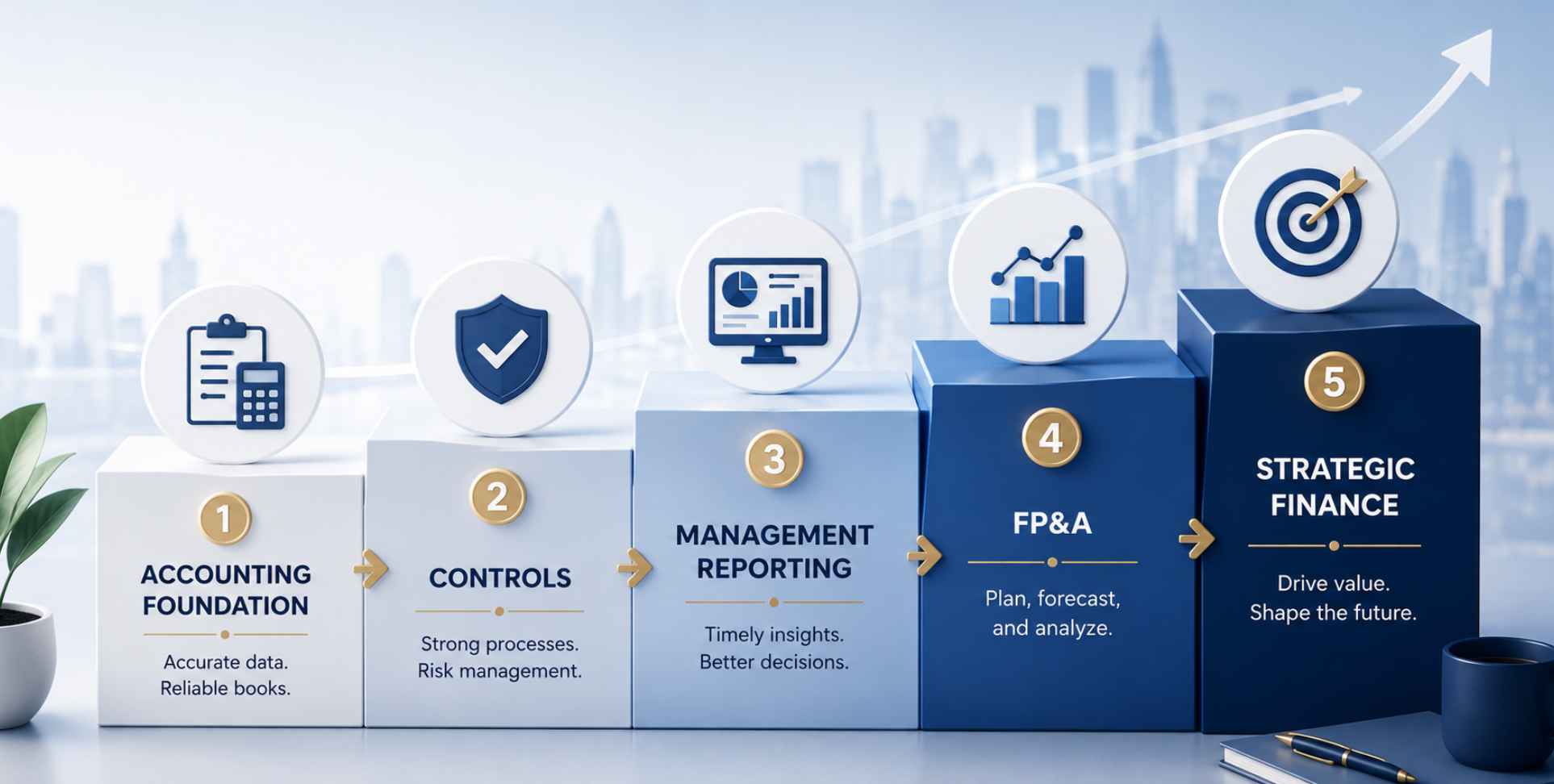
A scalable approach sits between those extremes:
Accounting Foundation → Controls → Management Reporting → FP&A → Strategic Finance
Each layer should develop as the business requires greater financial sophistication.
For a Delaware C-Corp planning to raise venture capital, that progression can be particularly important because the quality of financial information becomes increasingly visible to investors, boards, lenders, and due diligence teams.
Cash and Runway Become CFO-Level Responsibilities
For venture-backed C-Corps, cash management is rarely just treasury administration.
Cash represents the time available to achieve the next set of business milestones.
A CFO therefore builds a forward-looking cash framework around the company’s operating plan. Instead of simply reporting the bank balance, Finance should understand how revenue, collections, payroll, hiring, vendor commitments, taxes, and other expenses are expected to affect liquidity.
Suppose a startup has $8 million in cash and expects to hire 25 employees during the coming year.
A simple runway calculation based on historical burn may substantially overstate the company’s future liquidity if it does not incorporate those hires. Conversely, if hiring occurs more slowly than planned, runway may extend while the company potentially loses operating capacity required to achieve its targets.
The CFO connects those variables:
Cash → Hiring → Operating Expenses → Revenue Assumptions → Burn → Runway
This becomes particularly important around fundraising.
Founders need to know not only how much runway remains but also what milestones the company is expected to achieve during that period and when preparation for another financing round should begin.
For a venture-backed Delaware C-Corp, capital planning and operating planning should therefore be part of the same financial model.
The CFO Connects Equity Decisions With Financial Planning
Equity is a central component of many startup C-Corps.
The corporation may issue founder shares, create employee equity plans, issue preferred stock during financing rounds, grant stock options, or complete other equity transactions as the company develops.
The legal creation, authorization, and documentation of those instruments belongs with qualified corporate counsel and other appropriate specialists. But the CFO needs to understand how equity decisions interact with the financial structure of the company.
For example, management may need visibility into capitalization before a financing round. Finance may need to coordinate information used in due diligence. Equity-related compensation can have accounting and tax implications. New financing can affect cash planning, ownership analysis, and the company’s future operating budget.
The CFO can therefore help maintain a financial connection between:
Capitalization → Financing → Cash → Operating Plan → Future Capital Requirements
This is particularly valuable when fundraising becomes more sophisticated.
Investors may request historical financial statements, forecasts, capitalization information, revenue data, KPI calculations, cash analysis, and other materials during diligence. Those datasets should not exist as unrelated pieces of information.
The CFO helps make sure the company’s financial story is coherent.
Delaware Franchise Tax Requires Active Financial Attention
Delaware corporations have recurring state-level obligations even if their primary operations occur elsewhere.
The Delaware Division of Corporations states that corporations incorporated in Delaware are required to file an annual report and pay franchise tax. For active domestic corporations, the annual report and prior-year franchise tax are due by March 1. Delaware currently provides two principal franchise-tax calculation approaches for relevant corporations: the Authorized Shares Method and the Assumed Par Value Capital Method.
This is an area where financial oversight can matter significantly.
The amount assessed can depend on the calculation method and the corporation’s circumstances. Delaware currently states that the minimum tax under the Authorized Shares Method is $175, while the minimum under the Assumed Par Value Capital Method is $400; applicable maximums can be substantially higher.
A CFO can coordinate with the company’s tax and corporate specialists to make sure the appropriate information is available, deadlines are incorporated into the compliance calendar, and material obligations are reflected in financial planning.
This is a good example of why the CFO’s role extends beyond producing financial statements.
The finance organization needs a recurring calendar that connects accounting, tax, payroll, corporate obligations, investor reporting, and cash planning.
Missing a compliance requirement may create penalties, administrative problems, or unnecessary distraction for management. Delaware states that failure to file the required annual report and pay franchise tax by the applicable deadline can result in penalties and monthly interest.
The CFO helps make these requirements part of a controlled process rather than a founder’s reminder list.
A Delaware Corporation May Operate Across Multiple States
Being incorporated in Delaware does not mean the company operates only in Delaware.
A startup may have employees in California, executives in New York, customers across the country, remote employees in several states, and vendors throughout the United States.
That operational footprint can create additional financial, payroll, tax, registration, and compliance considerations.
The exact requirements depend on the company’s activities and should be evaluated with qualified legal and tax advisors. The CFO’s role is to ensure that operational expansion is reflected in the financial infrastructure.
If the company hires its first employee in a new state, Finance should understand whether payroll or other processes need to change.
If the startup opens a new office, the budget should reflect the full cost.
If customer activity creates new tax considerations, Finance should coordinate the appropriate analysis.
The broader principle is:
Delaware is the state of incorporation; the company’s financial responsibilities are shaped by where and how it actually operates.
For founders, this distinction becomes increasingly important as the startup grows.
International Founders Add Another Layer of Complexity
For founders outside the United States, a Delaware C-Corp may be part of a broader international corporate structure rather than a standalone business.
That can introduce intercompany transactions, multiple accounting systems, different currencies, shared employees, cross-border services, consolidated reporting, and additional tax and transfer-pricing considerations.
A CFO can help establish the financial operating relationship between entities.
Which company pays which expenses?
How are shared costs allocated?
How is the U.S. entity funded?
How are intercompany balances reconciled?
How does management view consolidated performance?
Which entity employs U.S. personnel?
How does the U.S. budget connect with the group’s global financial model?
The answers require collaboration across Finance, tax, accounting, and legal specialists.
But someone needs to make sure the pieces connect.
That coordination is a key CFO function.
Without it, international startups can reach a point where each entity has accounting records but management lacks a reliable consolidated view of the business.
The goal should be to establish those relationships early enough that financial complexity scales in a controlled way.
The CFO Makes the C-Corp Investor-Ready
A Delaware C-Corp is often selected in anticipation of institutional fundraising. But having the right legal entity does not automatically make a startup financially ready for investors.
Investor readiness requires reliable historical financial information and a credible view of the future.
A CFO can build the financial model, establish KPI reporting, maintain cash and runway analysis, prepare budget-versus-actual reporting, and organize financial materials for due diligence.
For a SaaS startup, that may involve connecting ARR, NRR, gross margin, CAC, headcount, burn, and runway with the underlying financial model.
For another business model, the relevant metrics may differ.
The principle remains the same.
Investors should be able to move from the startup’s strategic narrative to its operating metrics and then into the financial statements without encountering contradictions that management cannot explain.
The CFO helps establish that connection:
Accounting → KPIs → Forecast → Cash → Capital Requirements → Investor Story
That becomes increasingly important at Series A and beyond, when financial assumptions may receive greater scrutiny.
Board Reporting Becomes Part of the Financial Infrastructure
As a C-Corp raises institutional capital, governance typically becomes more structured.
The board may require recurring visibility into financial performance, cash, runway, hiring, forecasts, and key operating metrics.
A CFO helps establish a reporting cadence that gives directors meaningful financial information without overwhelming them with accounting detail.
A strong board finance package might connect actual performance with budget, explain material variances, update the forecast, show cash and runway, and highlight important operating KPIs.
But the real value comes from interpretation.
If burn increased, why?
If revenue missed plan, what changed?
If hiring accelerated, how does that affect runway?
If retention weakened, what does the forecast now assume?
If the company is considering another financing round, when does the cash model indicate that preparation should begin?
Board reporting therefore becomes an extension of the company’s management reporting rather than a separate quarterly exercise.
A mature financial rhythm looks something like:
Close → Analyze → Reforecast → Management Review → Board Reporting → Decisions
This gives founders and directors a shared financial framework for evaluating the company.
A CFO Creates Readiness for Due Diligence Before It Begins
Due diligence is considerably easier when the finance function has been built continuously rather than reconstructed immediately before a transaction.
Whether the company is preparing for fundraising, debt financing, an acquisition, or another strategic event, third parties may request financial statements, tax information, capitalization records, customer and revenue data, forecasts, contracts, payroll information, and other documentation.
The CFO can help establish data ownership and financial consistency long before those requests arrive.
If ARR is a key investor metric, its calculation should already be documented.
If board reporting uses a particular revenue measure, Finance should understand how it reconciles with accounting.
If the financial model assumes a specific hiring trajectory, the headcount plan should support it.
If intercompany balances exist, they should be reconciled.
This preparation does not guarantee that diligence will be simple. Complex transactions can create new questions.
But it significantly changes the starting point.
Instead of asking, “Where can we find this information?”, management can focus on “What does this information tell the investor?”
Does Every Delaware C-Corp Need a Full-Time CFO?
No.
The need for CFO-level capability and the need for a full-time CFO are two different questions.
An early-stage Delaware C-Corp may need sophisticated financial modeling, cash planning, fundraising support, board reporting, and financial infrastructure without having enough complexity to justify a permanent senior finance executive.
An outsourced or fractional CFO can provide those capabilities while working alongside accountants, Controllers, payroll providers, tax specialists, legal counsel, and internal management.
As the company scales, the structure can change.
Some finance responsibilities may move in-house. The company may hire a Controller or FP&A team. Eventually, the complexity of operations, fundraising, governance, or strategic transactions may justify a full-time CFO.
The appropriate model depends on the company’s stage.
The goal is not to hire the largest finance team possible.
It is to have the financial capabilities the company needs before complexity makes them urgent.
How ERB Proximo Supports Delaware C-Corps
For startups operating through a Delaware C-Corp, financial management can span several interconnected areas: accounting, controllership, payroll, tax compliance, FP&A, forecasting, cash management, investor reporting, and strategic CFO leadership.
ERB Proximo supports startups and growth companies operating in the United States through an integrated financial services model that includes outsourced CFO services, accounting, bookkeeping, controllership, payroll, tax compliance, U.S. entity setup, financial modeling, fundraising support, and financial operations for multinational companies.
This can be particularly relevant for international founders establishing a U.S. presence. Instead of treating entity setup, accounting, payroll, compliance, and strategic finance as independent workstreams, the company can build a financial infrastructure designed around how the U.S. business is expected to operate and scale.
With a U.S. presence in California and New York, ERB Proximo supports startups across important U.S. technology and investment ecosystems.
The objective is not merely maintaining the Delaware corporation.
It is helping founders build a finance function capable of supporting what the corporation is intended to become.
Frequently Asked Questions
What financial responsibilities does a Delaware C-Corp have?
Responsibilities depend on the company’s activities, but they may include accounting, federal and state tax filings, Delaware annual reporting and franchise tax, payroll obligations, financial reporting, and additional state-level requirements. Companies should work with qualified legal and tax professionals to determine their specific obligations.
Does a Delaware C-Corp have to file an annual report?
Yes. Delaware states that domestic corporations must file an annual report and pay applicable franchise tax, generally by March 1 for the prior year.
Does a Delaware C-Corp need to file a federal tax return if it has no taxable income?
IRS instructions state that, unless exempt, domestic corporations generally must file an income tax return whether or not they have taxable income.
What is Delaware franchise tax?
It is an annual tax imposed on Delaware corporations for the corporate franchise. The amount can depend on the applicable calculation method and corporate structure.
Does a startup need a full-time CFO after incorporating in Delaware?
Not necessarily. Early and growth-stage startups can use outsourced or fractional CFO support until their scale and complexity justify a permanent CFO.
Can a CFO handle legal and tax requirements?
A CFO should not replace qualified legal or tax advisors. The CFO can coordinate financial information, planning, processes, and specialists so that legal and tax requirements are incorporated into the broader financial infrastructure.
Incorporation Creates an Entity. Finance Builds a Company.
Founders often devote substantial attention to the decision to form a Delaware C-Corp.
That decision matters.
But from a financial management perspective, what happens afterward is considerably more important.
The company must turn a legal entity into an operating organization capable of hiring people, paying vendors, collecting revenue, managing cash, reporting to investors, complying with recurring requirements, forecasting its future, and allocating capital intelligently.
Those capabilities do not appear automatically when the Certificate of Incorporation is filed.
They have to be built.
A CFO’s role is to help founders make sure that the financial organization develops alongside the corporation — not several steps behind it.
Because the real objective is not simply to maintain a Delaware C-Corp in good standing.
It is to build a company that is financially prepared to scale.