
A startup can grow surprisingly far without formal financial infrastructure.
In the beginning, that is often appropriate. The founders monitor cash, an external accountant manages the books, payroll runs through a separate platform, budgets live in spreadsheets, and financial decisions are made through direct conversations among a small leadership team.
Then the company scales.
Twenty employees become seventy. One department becomes six. Institutional investors join the cap table. Revenue becomes more complex. Employees are hired across multiple states. Department heads begin controlling meaningful budgets. Board reporting becomes more demanding. Another funding round appears on the horizon.
At this stage, the problem is not necessarily that finance is being managed poorly. The problem is that financial processes designed for a small startup are being asked to support a much more sophisticated organization.
Building financial infrastructure is one of the most important responsibilities of a startup CFO.
But financial infrastructure does not simply mean implementing an ERP or buying more finance software. It is the combination of people, processes, systems, controls, data, reporting, and financial governance that allows management to understand the business and make decisions confidently as complexity increases.
The best CFOs build that infrastructure progressively. The goal is not to make a startup operate like a public company before it needs to. It is to create enough structure for the company’s next stage without sacrificing the speed that made growth possible in the first place.
Financial Infrastructure Starts With Reliable Financial Data
Before building sophisticated dashboards, forecasts, or board reports, a CFO needs confidence in the financial information underneath them. This sounds obvious, but it is one of the most common weaknesses in rapidly growing companies. Different systems may contain different versions of revenue, headcount, expenses, customer data, and forecasts. Accounting closes may take too long. Expense classifications may change from month to month. Management reports may require extensive manual adjustments before leadership can use them.
A CFO begins by understanding how financial information moves through the organization. Where does revenue data originate? How are expenses approved and recorded? How does payroll reach the general ledger? Who owns the monthly close? How are accruals handled? Where does headcount information live? Which numbers are considered authoritative when Finance, Sales, and Operations report different results?
The objective is to create a financial foundation management can trust.
That may require improving accounting processes, defining responsibilities, standardizing the chart of accounts, strengthening reconciliation procedures, establishing a reliable close calendar, or integrating previously disconnected systems. The specific solution depends on the company’s stage and complexity.
This foundational work is strategically important because every higher-level finance capability depends on it. A 24-month forecast can look sophisticated and still be useless if the underlying expense or revenue data is unreliable.
A CFO therefore builds financial infrastructure from the bottom up: first establishing confidence in the numbers, then creating the analytical capabilities that allow management to use those numbers.
The CFO Creates a Financial Operating Rhythm
Infrastructure is not only about systems. It is also about cadence.
As startups scale, financial management needs to become a recurring operating process rather than something leadership addresses primarily around board meetings, fundraising, or annual budgeting.
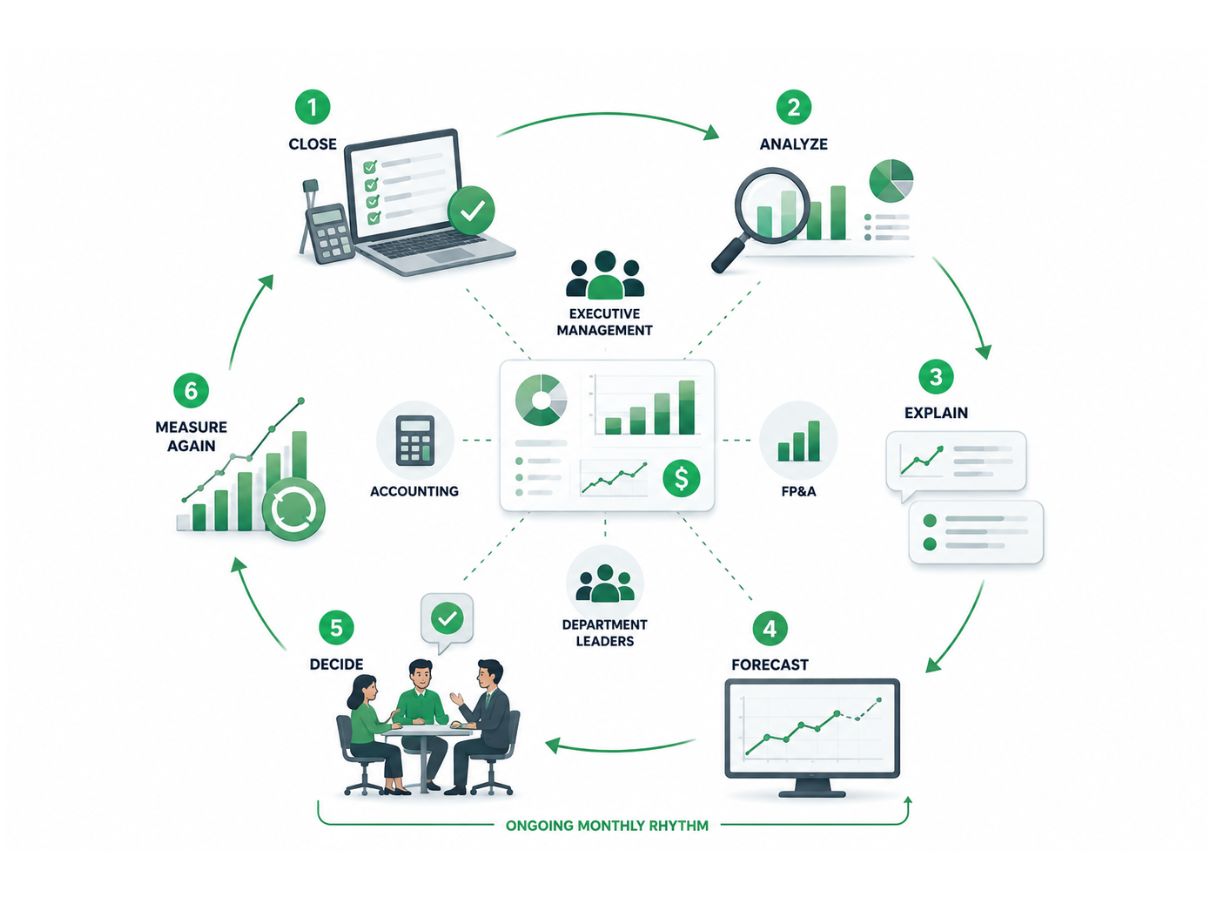
A CFO can establish a monthly financial rhythm that connects accounting, FP&A, department leaders, and executive management. Once the accounting period closes, actual performance can be compared with budget and forecast. Significant variances can be investigated. Department leaders can review spending and hiring. Revenue assumptions can be updated. Cash expectations can be reassessed. The forecast can then reflect what management has learned.
This creates a continuous cycle:
Close → Analyze → Explain → Forecast → Decide → Measure Again
The value of this process extends far beyond finance. Department leaders become more accountable for their assumptions. Management sees changes earlier. Budget conversations become connected to actual performance. Forecasting becomes an ongoing activity rather than an annual exercise.
For example, if Sales hiring occurs faster than planned while bookings remain below forecast, management can see the combination early. If Engineering hiring is delayed, Finance can show how that affects both product plans and runway. If customer collections slow, the cash forecast can be adjusted before liquidity becomes a concern.
A mature financial operating rhythm gives management something that rapidly growing companies often lack: a consistent mechanism for converting business activity into financial decisions.
Building FP&A and a Forward-Looking Financial Model
Once reliable historical information exists, the CFO needs to build the company’s forward-looking financial capability.
This is where FP&A becomes central.
A startup financial model should not simply take last year’s numbers and increase them by a percentage. It should reflect the operating drivers of the actual business. For a SaaS company, for example, the model may connect sales capacity, pipeline, new ARR, expansion, churn, revenue, gross margin, headcount, operating expenses, burn, and cash.
The CFO’s role is to ensure these assumptions connect logically.
If management wants to hire ten additional account executives, the model should show when those employees are expected to start, how long they will take to ramp, what commercial capacity they may create, and what happens to burn before the expected revenue arrives. If retention changes, management should understand the effect on future recurring revenue. If a major product investment is accelerated, the cash implications should become visible immediately.
The forecast also needs to evolve. A company operating under a $15 million annual budget in January may be facing a materially different business environment by June. The CFO therefore introduces rolling forecasts and scenario planning so management can continuously update its expectations.
This creates infrastructure for answering one of the most important questions in startup finance:
If we make this decision today, what could it mean financially six, twelve, or eighteen months from now?
Creating Financial Controls Without Slowing the Startup Down
Financial controls can be misunderstood in startup environments. Founders sometimes associate them with bureaucracy, multiple approvals, and processes that make the company slower.
Poorly designed controls can certainly do that.
Good controls should do the opposite: they create clarity about who can make decisions, what requires approval, and where financial responsibility sits.
As the organization grows, informal processes become increasingly difficult to manage. A $5,000 software contract may have been insignificant when the company had five vendors. It becomes a different issue when dozens of employees can independently commit the company to recurring expenses. Hiring approvals, purchasing authority, expense policies, vendor onboarding, payment controls, and access to financial systems all become more important as scale increases.
A CFO should design controls proportionate to the company’s stage and risk.
The objective is not to require CFO approval for every expense. It is to establish sensible thresholds and ownership. Department leaders should understand their budgets. Managers should know which commitments they can authorize. Material contracts should receive appropriate review. Cash movements should have appropriate safeguards. Finance should be able to identify significant commitments before they unexpectedly appear in actual spending.
Strong infrastructure therefore creates controlled autonomy.
Teams can move quickly within clearly defined boundaries, while management maintains visibility over decisions that could materially affect the company.
That balance is particularly important for startups, where excessive control can inhibit growth but insufficient control can create financial surprises.
Connecting Headcount to the Financial Infrastructure
Headcount deserves special attention because people are often the largest cost category for a growing startup.
In an early-stage company, hiring may be managed through conversations between founders and department leaders. As the organization scales, that becomes increasingly difficult. HR may maintain one hiring plan, Finance another, and department heads a third. Start dates change, compensation assumptions become outdated, and the financial forecast gradually loses connection with the actual recruiting pipeline.
A CFO can establish a single financial framework for headcount planning.
Approved positions, expected start dates, compensation, bonuses, commissions, benefits, payroll-related costs, and other relevant assumptions should flow into the company’s forecast. When a hiring date changes, Finance should be able to understand the financial effect. When management adds a new position, the impact on departmental spending, burn, and runway should become visible.
The infrastructure should also distinguish between approval and assumption. A position included in a financial model is not necessarily approved for hiring, and an approved position may not start on the originally forecast date. Clear processes prevent these distinctions from becoming blurred.
As companies expand across the United States, headcount infrastructure becomes even more important because hiring in multiple states can introduce additional payroll, tax, benefits, employment, and compliance considerations that require qualified specialists.
The CFO does not replace those specialists. The CFO ensures that the financial consequences of the company’s workforce strategy are incorporated into planning and decision-making.
Building Management, Board, and Investor Reporting
A scalable finance function should not produce the same report for every audience.
Department managers need operational budget visibility. Executive management needs a consolidated view of performance and forecast changes. Board members need a higher-level perspective on growth, cash, runway, KPIs, major variances, and strategic financial issues. Investors may require additional information depending on the company’s stage and financing structure.
A CFO creates reporting infrastructure that uses a consistent financial foundation while presenting information at the appropriate level for each audience.
This is particularly important because rapidly growing startups often develop multiple versions of the truth. Sales reports one revenue metric, Finance another. ARR calculations differ between board presentations. Headcount numbers change depending on which spreadsheet is opened. Forecast assumptions are updated without being reflected everywhere else.
Financial infrastructure should reduce these inconsistencies.
The CFO can establish standardized KPI definitions, reporting calendars, ownership of key metrics, and repeatable board reporting processes. Over time, preparing financial materials should become less dependent on heroic manual effort.
The objective is not merely efficiency.
Consistency creates credibility.
When founders can explain why results changed, how the forecast has evolved, what management expects next, and what assumptions support those expectations, financial reporting becomes a strategic management capability rather than an administrative requirement.
What Does a Startup Financial Infrastructure Actually Include?
The architecture will vary, but a growing U.S. startup may eventually need an integrated framework across several areas:
| Financial Layer | Purpose |
|---|---|
| Accounting | Reliable historical financial records |
| Controllership | Close, controls and financial integrity |
| FP&A | Budgeting, forecasting and analysis |
| Cash Management | Liquidity and runway visibility |
| Headcount Planning | Connect workforce decisions to the forecast |
| KPI Framework | Consistent measurement of business performance |
| Management Reporting | Support executive decision-making |
| Board Reporting | Communicate performance, outlook and risk |
| Financial Systems | Connect and automate financial information |
| CFO Leadership | Convert financial information into strategic action |
The technology supporting these layers matters, but technology should follow the operating model rather than define it.
A CFO should first determine what the company needs to know, who owns the information, how decisions should be made, and where existing processes are failing. Only then should systems be selected or replaced.
Building Infrastructure for the Next Stage, Not the Final Stage
One of the marks of experienced CFO leadership is knowing how much infrastructure is enough.
A Series A startup does not need every process that a public company requires. Building too much too early consumes money, management attention, and organizational energy. Building too little creates financial risk and eventually forces the company into painful reconstruction.
The CFO therefore needs to think one stage ahead.
If the company expects to double headcount, can the existing budgeting and approval process support it?
If a Series B is planned, can Finance produce the information investors are likely to request?
If the startup expects to expand from New York into California and other states, are financial processes capable of supporting a distributed organization?
If revenue is expected to triple, will current reporting remain useful?
If the board becomes more institutional, can management provide consistent financial information without rebuilding every presentation manually?
This approach changes the objective from “building a sophisticated finance department” to removing financial constraints before they become obstacles to growth.
The best infrastructure often feels almost invisible. Management gets information when it needs it. Responsibilities are clear. Financial surprises decline. Forecasts can be updated efficiently. The organization can become more complex without Finance becoming proportionally more chaotic.
That is the standard a growing startup should aim for.
How ERB Proximo Helps Build Financial Infrastructure for U.S. Startups
Building financial infrastructure can be difficult when a startup has several disconnected providers handling different pieces of finance.
Accounting may sit with one team. Forecasting lives with a founder. Reporting is maintained internally. Strategic finance comes from another advisor. Each component may function independently, but management still has to connect them.
ERB Proximo can support U.S. startups through an integrated financial model that brings together capabilities across outsourced CFO leadership, FP&A, controllership, accounting, forecasting, and management reporting, based on the company’s stage and requirements.
This structure allows financial infrastructure to develop progressively.
A company may initially need stronger accounting and management reporting. As it grows, FP&A and rolling forecasts become more important. Institutional funding may create greater requirements around board reporting, scenario analysis, cash planning, and capital allocation. CFO involvement can expand as those strategic decisions become more consequential.
With operations in California and New York, ERB Proximo supports companies operating within major U.S. startup ecosystems where businesses can move rapidly from relatively simple financial requirements to sophisticated institutional expectations.
The objective is not to impose a predetermined finance structure.
It is to help build a financial organization that is appropriate for the company today, while capable of supporting where management intends to take it next.
Frequently Asked Questions
What is financial infrastructure in a startup?
Financial infrastructure is the combination of people, processes, systems, controls, financial data, forecasting, reporting, and governance that allows a company to manage its finances reliably and make informed decisions as it grows.
When should a startup build financial infrastructure?
The process should begin early but become more sophisticated as complexity increases. Institutional funding, rapid hiring, increasing burn, multi-state operations, board requirements, and upcoming fundraising are common reasons to strengthen infrastructure.
Does building financial infrastructure require an ERP?
Not necessarily. Technology should match the company’s needs and stage. Many startups can build effective financial processes before requiring a sophisticated ERP environment.
What is the CFO’s role in financial systems?
The CFO helps determine what financial information management needs, how processes should operate, where controls are required, and which systems can support those requirements efficiently.
Can financial infrastructure be outsourced?
Yes. Startups may outsource accounting, controllership, FP&A, CFO services, or multiple functions together before the scale of the business justifies building a complete internal finance department.
Financial Infrastructure Is Really About Organizational Readiness
There is a useful way for founders to think about financial infrastructure that has little to do with accounting software.
Imagine the company receives an unexpected opportunity tomorrow.
A major enterprise customer wants to sign a significantly larger contract. Management wants to open another U.S. office. The board proposes accelerating growth. Twenty new hires need approval. An investor asks whether the company could raise six months later than planned. A potential acquisition suddenly becomes available.
Could leadership quickly understand the financial implications?
Could Finance model the decision?
Could management see the impact on cash and runway?
Could department leaders understand what changes in their budgets?
Could the board receive reliable information without several weeks of manual reconstruction?
If the answer is yes, the company has built something more valuable than a collection of finance systems.
It has built financial readiness.
That is ultimately what CFO-led financial infrastructure should provide: an organization capable of absorbing greater complexity, evaluating opportunities quickly, and making consequential decisions without losing confidence in its financial foundation.