
As startups grow, finance becomes more specialized.
In the earliest stages, founders may rely on a bookkeeper, an external accountant, and a few spreadsheets to manage the company’s financial activity. That structure can work when transaction volume is limited, reporting requirements are simple, and most financial decisions are made directly by the founders.
Eventually, however, the questions change.
Management no longer asks only:
“Are our books accurate?”
It also asks:
“How much runway do we have?”
“Can we afford the hiring plan?”
“What happens if revenue misses forecast?”
“What will investors expect next quarter?”
“Are we ready for the next financing round?”
Those questions expose an important distinction between two senior finance roles that founders frequently confuse: the Controller and the Chief Financial Officer (CFO).
Both are important.
Both can influence the quality of a startup’s finance function.
But they solve very different problems.
A Controller is primarily responsible for ensuring that the company’s financial information is accurate, complete, controlled, and produced on time.
A CFO uses that information to help management determine what the company should do next.
For growing U.S. startups, understanding that difference can prevent two common mistakes: hiring CFO-level leadership when the real problem is accounting execution, or expecting a Controller to provide strategic financial leadership that falls outside the role.
The Short Answer: CFO vs. Controller
The simplest way to understand the distinction is this:
The Controller owns financial accuracy. The CFO owns financial direction.
A Controller typically focuses on the integrity of accounting operations.
A CFO focuses on financial strategy, planning, capital, growth, and decision-making.
The Controller is generally asking:
“Are the numbers right?”
The CFO is asking:
“What do the numbers mean, and what should we do about them?”
The two roles are complementary rather than interchangeable.
A sophisticated finance organization needs reliable historical information and strong forward-looking financial leadership.
What Does a Controller Do?
The Controller is usually the senior accounting leader within an organization.
The role is responsible for creating reliable financial information and ensuring that the company’s accounting processes operate consistently.
Typical Controller responsibilities include:
- Monthly close
- General ledger oversight
- Account reconciliations
- Accounts payable
- Accounts receivable
- Financial statement preparation
- Accounting policies
- Internal controls
- Expense classification
- Payroll accounting
- Audit coordination
- Supporting tax compliance
- Revenue accounting
- Maintaining accounting documentation
For startups, an experienced Controller can bring discipline to an accounting function that may previously have depended on several disconnected providers or founder-managed processes.
A strong Controller creates confidence in the underlying financial data.
That matters because every strategic financial decision ultimately depends on the quality of the information supporting it.
What Does a CFO Do?
The CFO operates at a different level.
Rather than primarily managing the accounting record, the CFO uses financial information to support company strategy.
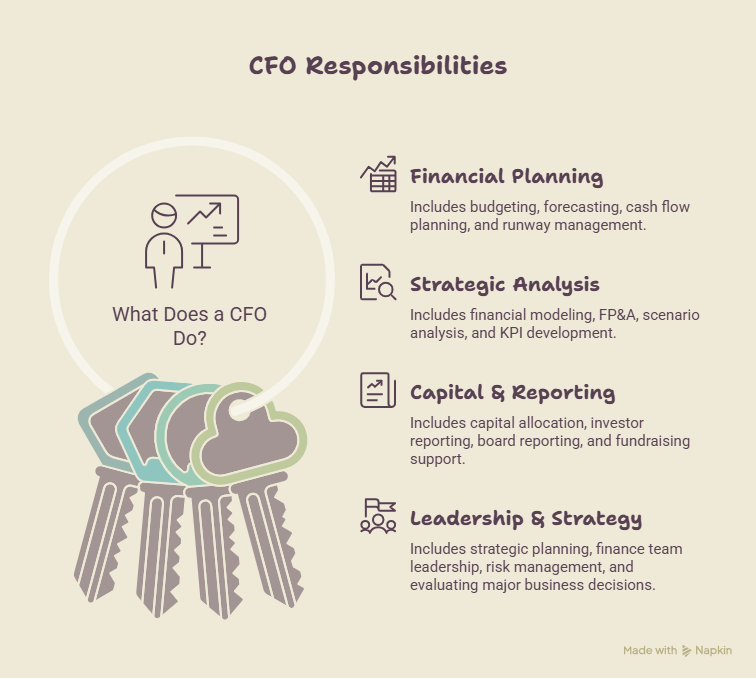
Typical startup CFO responsibilities include:
- Budgeting
- Forecasting
- Cash flow planning
- Runway management
- Financial modeling
- FP&A
- Capital allocation
- Investor reporting
- Board reporting
- Fundraising support
- Scenario analysis
- KPI development
- Strategic planning
- Finance team leadership
- Risk management
- Evaluating major business decisions
The CFO works closely with the CEO and other executives to connect company strategy with financial consequences.
If management wants to accelerate hiring, enter a new market, change pricing, raise another round, or reduce burn, the CFO should help quantify those decisions before they are made.
That is fundamentally different from accounting.
CFO vs. Controller: Side-by-Side Comparison
| Area | Controller | CFO |
|---|---|---|
| Primary focus | Financial accuracy | Financial strategy |
| Orientation | Historical | Forward-looking |
| Accounting ownership | High | Oversight |
| Monthly close | Leads | Reviews |
| Reconciliations | Leads | Limited involvement |
| Financial statements | Produces | Interprets |
| Budgeting | Supports | Leads |
| Forecasting | Supports | Leads |
| Cash runway | Provides inputs | Manages strategically |
| Board reporting | Supplies data | Leads financial narrative |
| Investor reporting | Supports | Leads |
| Fundraising | Limited | Strategic role |
| Scenario planning | Limited | Core responsibility |
| KPI strategy | Supports | Defines and interprets |
| Internal controls | Leads | Oversees |
| Capital allocation | Limited | Core responsibility |
| Management decision support | Operational | Strategic |
The table illustrates why startups often need both capabilities as they scale.
Why Founders Commonly Confuse the Two Roles
The confusion is understandable.
In small companies, finance roles overlap.
A Controller may help with budgets.
A CFO may review accounting issues.
A senior accountant may temporarily act as Controller.
A fractional CFO may oversee the entire finance team.
Titles also vary between organizations.
The problem begins when founders assume that because someone is senior in finance, that person can automatically perform every finance function effectively.
This can lead to mismatched expectations.
For example, a technically excellent Controller may maintain accurate financial statements but have limited experience with venture fundraising or strategic forecasting.
Conversely, an experienced CFO may be excellent at financial modeling and investor communication but should not personally be spending significant executive time reconciling bank accounts every month.
The strongest finance organizations put the right expertise at the right level.
How to Know If Your Startup Needs a Controller
A Controller becomes valuable when accounting complexity begins increasing.
Common signs include:
Month-End Close Takes Too Long
If management cannot receive reliable financial statements until weeks after the month ends, the accounting process may need stronger ownership.
The Books Require Frequent Corrections
Repeated adjustments, inconsistent classifications, unreconciled accounts, or unexplained balances can signal that accounting infrastructure has not kept pace with growth.
Multiple Providers Are Handling Different Parts of Accounting
One provider manages payroll, another bookkeeping, another accounts payable, and a CPA makes year-end adjustments.
Without coordination, management may lack a single person responsible for financial accuracy.
Transaction Volume Is Increasing
More customers, vendors, employees, subscriptions, and bank accounts create greater accounting complexity.
The Company Is Preparing for an Audit or Due Diligence
Reliable books and organized supporting documentation become particularly important when external parties begin examining financial information.
Internal Controls Are Weak
As the company grows, informal founder approvals may no longer provide sufficient financial control.
The Controller helps formalize those processes without creating unnecessary bureaucracy.
How to Know If Your Startup Needs a CFO
A CFO becomes valuable when management needs help making forward-looking financial decisions.
Common signals include:
You Need a Reliable Forecast
A startup may have accurate financial statements but still lack visibility into the next 12–24 months.
That is a CFO problem.
Runway Has Become Strategically Important
When management begins evaluating the relationship between cash, burn, hiring, growth, and fundraising, CFO-level planning becomes increasingly valuable.
You Are Raising Institutional Capital
Fundraising typically requires financial modeling, investor reporting, due diligence preparation, KPI analysis, and a defensible financial plan.
The Board Requires More Sophisticated Reporting
Boards expect interpretation, not simply financial statements.
A CFO helps management explain what changed, why it changed, and what should happen next.
Major Decisions Require Financial Modeling
New hiring plans, geographic expansion, pricing changes, or major sales investments should be evaluated through scenario analysis.
The Founder Is Making Financial Decisions Without Enough Support
Founders should make decisions.
They should not need to build every financial analysis themselves.
What If the Startup Needs Both?
This is common.
A growing company may simultaneously have two different problems:
Problem 1: The accounting infrastructure is not reliable enough.
Problem 2: Management lacks strategic financial leadership.
Hiring only a CFO does not automatically fix the first problem.
Hiring only a Controller does not solve the second.
The ideal structure may look like:
Bookkeeping → Controller → CFO
Each layer serves a different purpose.
Bookkeeping captures financial transactions.
The Controller ensures accounting integrity.
The CFO turns reliable financial information into strategic decisions.
This creates what management ultimately needs: a finance function that can both report the past accurately and plan the future intelligently.
Can a Controller Report to a CFO?
Yes, and that is a common organizational structure.
The Controller typically manages accounting operations while reporting to the CFO.
This allows the CFO to focus more heavily on strategic responsibilities while maintaining oversight of accounting quality.
For example:
The Controller may lead the monthly close and prepare financial statements.
The CFO reviews those statements, analyzes variances, incorporates the results into the forecast, and discusses the strategic implications with management.
That separation of responsibilities becomes increasingly valuable as the company grows.
Controller vs. CFO in a Seed-Stage Startup
A Seed-stage company may not need either position on a full-time basis.
Its needs depend on complexity.
If the startup has recently raised capital but still has relatively simple accounting, outsourced bookkeeping plus fractional CFO support may be sufficient.
If accounting has become more complex, the company may need outsourced controllership as well.
A practical Seed-stage finance structure might include:
- Outsourced bookkeeping
- Part-time Controller oversight
- Fractional CFO leadership
This gives the company access to multiple levels of expertise without prematurely building a large internal finance team.
Controller vs. CFO at Series A
Series A often creates a meaningful transition.
Headcount increases.
Investor reporting becomes more formal.
The operating plan becomes more detailed.
Budgets begin receiving greater scrutiny.
Management needs more reliable forecasting.
The company may also be preparing for subsequent financing sooner than expected.
At this stage, both controllership and CFO capabilities can become important.
The Controller creates reliable accounting infrastructure.
The CFO connects that infrastructure to growth strategy.
Controller vs. CFO at Series B and Beyond
Later-stage startups often require significantly more sophisticated finance organizations.
The company may have:
- Multiple departments
- Significant headcount
- International operations
- More complex revenue
- Greater transaction volume
- Larger boards
- Institutional investors
- Audits
- Debt facilities
- Increasing regulatory requirements
The Controller may oversee an accounting team while the CFO manages FP&A, capital strategy, investor relations, board communication, and finance leadership.
At this point, separating accounting leadership from strategic finance leadership becomes increasingly important.
CFO vs. Controller for SaaS Startups
SaaS companies illustrate the distinction particularly well.
A Controller may focus on:
- Revenue accounting
- Deferred revenue
- Expenses
- Payroll accounting
- Financial statement integrity
- Month-end close
The CFO may focus on:
- ARR
- MRR
- NRR
- GRR
- Churn
- CAC
- LTV
- CAC Payback
- Gross Margin
- Burn Multiple
- Cash Runway
- Revenue forecasts
The Controller ensures the underlying revenue data is properly reflected in the financial statements.
The CFO evaluates what those economics imply about company performance and growth strategy.
Both perspectives matter.
Who Owns Budgeting: CFO or Controller?
Budgeting is generally a CFO-led process.
The Controller can provide historical financial data and ensure the resulting budget aligns appropriately with the accounting structure.
But budgeting is fundamentally forward-looking.
It involves strategic decisions about:
- Hiring
- Marketing investment
- Sales capacity
- Product development
- Capital expenditures
- Growth priorities
- Cash requirements
The CFO typically coordinates these assumptions across management and converts them into an integrated financial plan.
Who Owns Forecasting?
Forecasting is also usually CFO or FP&A territory.
A forecast should evolve continuously as actual results and business assumptions change.
The Controller provides accurate actual financial information.
The CFO then uses that information to update expectations for future performance.
This creates a continuous cycle:
Actual Results → Analysis → Updated Forecast → Management Decision → New Actual Results
When this cycle works well, finance becomes part of the operating system of the company.
Who Owns Cash Flow?
Both roles contribute, but in different ways.
The Controller ensures cash transactions are accurately recorded and reconciled.
The CFO evaluates future liquidity strategically.
The CFO may ask:
- When will cash reach a critical threshold?
- What happens if collections slow?
- How much runway does the hiring plan consume?
- When should fundraising begin?
- Which expenses should be delayed under a downside scenario?
Cash management becomes strategic when it influences company decisions.
Who Works with the Board?
The CFO typically leads financial communication with the board.
The Controller may help prepare supporting information, but the CFO is responsible for explaining performance within a broader strategic context.
A board does not simply want to know that payroll increased.
It wants to understand:
Why did payroll increase?
Was it planned?
Did hiring occur earlier than expected?
What does that change do to runway?
Does management recommend modifying future hiring?
That interpretation is CFO territory.
Who Supports Fundraising?
The CFO usually plays the larger strategic role.
Fundraising support may involve:
- Financial modeling
- Capital requirements
- Cash runway
- Scenario planning
- Investor KPI preparation
- Due diligence
- Historical analysis
- Management presentations
- Investor Q&A
The Controller supports this process by ensuring the underlying financial information is accurate, documented, and consistent.
Once again, the roles reinforce each other.
California Startups: When Do You Need a Controller or CFO?
California startups can grow into financial complexity quickly, particularly in technology, SaaS and AI.
A company raising institutional capital and rapidly expanding headcount may need CFO involvement earlier than a bootstrapped business of similar size.
At the same time, California operations may introduce increasing accounting, payroll, tax, and compliance complexity that requires stronger Controller oversight.
The question should therefore not be:
“Are we large enough?”
It should be:
“Which financial problem are we trying to solve?”
If the problem is accounting accuracy and close discipline, consider Controller support.
If the problem is forecasting, runway, fundraising or financial strategy, CFO support is likely more appropriate.
If both problems exist, the company may need both capabilities.
New York Startups: Building the Right Finance Layer
New York startups frequently operate in sectors such as FinTech, SaaS, AI, healthcare, media, marketplaces and e-commerce.
These companies may encounter sophisticated investor and reporting expectations relatively early.
A New York startup preparing for an institutional financing round may require CFO-level modeling and investor support while simultaneously needing stronger Controller processes to improve reporting quality.
Rather than hiring based on title, founders should map each financial responsibility to the appropriate level of expertise.
Do You Need Full-Time Employees for Both Roles?
Not necessarily.
One of the advantages available to modern startups is the ability to build a sophisticated finance organization through outsourced professionals before the company is large enough to justify permanent hires.
For example:
Early Stage
Bookkeeper + Fractional CFO
Growth Stage
Bookkeeper + Outsourced Controller + Fractional CFO
Later Stage
Internal Accounting Team + Controller + Full-Time CFO
The organization should evolve with the business.
The goal is not to outsource forever.
Nor is it to hire internally as quickly as possible.
The goal is to deploy financial expertise efficiently at every stage.
What Happens When You Hire a CFO Without a Strong Controller Function?
This is an important issue.
A CFO cannot provide reliable strategic advice if the underlying financial information is weak.
Imagine management asks:
“How much can we afford to hire next quarter?”
The CFO builds a model based on financial statements.
But if payroll has been misclassified, accounts are unreconciled, deferred revenue is inaccurate, or expenses are recorded inconsistently, the forecast inherits those problems.
Strategic finance requires reliable inputs.
This is why sophisticated CFO services often work best when combined with strong controllership.
What Happens When You Have a Controller but No CFO?
The opposite situation is equally common.
The company may have immaculate books.
Monthly close is excellent.
Financial statements arrive on time.
Every account reconciles.
But management still does not know:
- How much runway remains under different scenarios
- Whether the hiring plan is affordable
- When the company should raise again
- Which KPIs investors should see
- Whether growth is capital-efficient
- How actual results compare with strategic expectations
Accurate accounting alone cannot answer those questions.
The company has financial information but lacks financial leadership.
How ERB Proximo Brings CFO and Controller Capabilities Together
For many startups, the question of CFO vs. Controller is ultimately the wrong question.
The real issue is whether the company has both financial integrity and financial leadership.
ERB Proximo provides an integrated finance model designed around that distinction.
Rather than treating CFO advice, controllership, accounting and reporting as unrelated services, the firm can bring these functions together within one coordinated finance organization.
The Controller layer helps ensure that financial information is accurate, consistent and produced on time.
The CFO layer uses that information to support forecasting, cash management, capital strategy, investor reporting, board communication and management decisions.
This integrated structure can be particularly valuable for startups that have outgrown basic bookkeeping but are not yet ready to build every finance position internally.
With a presence in California and New York, ERB Proximo works with U.S. startups and growth companies facing increasingly sophisticated financial requirements across major startup ecosystems.
The result is not simply outsourced accounting or periodic CFO advice.
It is a finance function designed to mature alongside the business.
Founder Decision Framework: CFO, Controller or Both?
Consider Controller support when:
Month-end close is inconsistent or slow.
Financial statements require frequent corrections.
Account reconciliations are incomplete.
Accounting policies need stronger ownership.
Multiple accounting providers require coordination.
Transaction volume has increased substantially.
You are preparing for an audit or due diligence.
Internal financial controls need improvement.
Consider CFO support when:
Cash runway has become strategically important.
You need a rolling forecast.
You are preparing to raise capital.
Your board expects more sophisticated reporting.
You need financial scenario planning.
Your hiring plan requires financial analysis.
Management needs stronger KPI reporting.
The founder is making major financial decisions without senior finance support.
Consider both when:
Accounting accuracy needs improvement and management also needs strategic finance leadership.
The company is scaling rapidly.
Institutional investors are increasing reporting expectations.
Financial complexity has outgrown a single-provider solution.
The business needs both reliable historical reporting and forward-looking decision support.
Frequently Asked Questions
What is the main difference between a CFO and a Controller?
A Controller primarily manages accounting accuracy, financial reporting, the monthly close, reconciliations, and financial controls. A CFO focuses primarily on financial strategy, forecasting, cash management, capital allocation, fundraising, and management decision support.
Does a startup need a CFO or Controller first?
It depends on the problem. If accounting processes and financial statements are unreliable, Controller support may be the immediate priority. If accounting is already strong but management lacks forecasting or strategic financial leadership, a CFO may be needed first.
Can one person be both CFO and Controller?
In smaller companies, responsibilities may overlap. As the company scales, separating strategic finance from accounting operations generally provides clearer ownership and allows each role to focus on its core responsibilities.
Does a Controller report to a CFO?
Often, yes. In many finance organizations, the Controller leads accounting operations and reports to the CFO, who oversees the broader finance strategy.
Is a CFO more senior than a Controller?
In a typical corporate structure, yes. The CFO is usually part of the executive leadership team and oversees the broader finance organization, while the Controller leads accounting.
Does a CFO manage bookkeeping?
A CFO may oversee the overall finance function, but bookkeeping is generally performed by accounting professionals. Senior CFO time is better spent on strategic financial decisions than routine transaction processing.
Can an outsourced CFO work with an outsourced Controller?
Yes. This can be an effective model for startups that need sophisticated finance capabilities without hiring a full internal finance department.
When should a SaaS startup hire a Controller?
A SaaS startup may need Controller support when revenue accounting, transaction volume, reporting requirements, or month-end close processes become too complex for basic bookkeeping.
When should a startup hire both a Controller and CFO?
Both may be appropriate when the company requires stronger accounting controls while simultaneously needing forecasting, investor reporting, fundraising support, and strategic finance leadership.
Which role is more important during fundraising?
The CFO typically leads strategic fundraising support, financial modeling, forecasting, and investor communication. The Controller plays an essential supporting role by ensuring historical financial information is accurate and due-diligence-ready.
Strong Finance Requires Both Accuracy and Direction
The CFO vs. Controller debate should not be framed as a competition between two finance roles.
They solve different problems.
The Controller creates confidence in the financial information.
The CFO creates confidence in the financial decisions made from that information.
A startup can survive for a period without one or both roles.
But as the business becomes more complex, the distinction becomes increasingly important.
Founders should first identify the real constraint.
If the company cannot trust its numbers, strengthen controllership.
If management trusts the numbers but does not know what they imply for the future, strengthen CFO leadership.
If both challenges exist, build both capabilities.
The strongest startup finance organizations do not choose between accurate accounting and strategic finance.
They build a structure in which the Controller makes the numbers reliable, and the CFO makes them useful.